
Mobile App Development Cost in India: What Your Budget Includes
Plan an app budget around real user journeys, platform choices, backend work, testing, store submission, and ongoing costs—not a misleading price per screen.
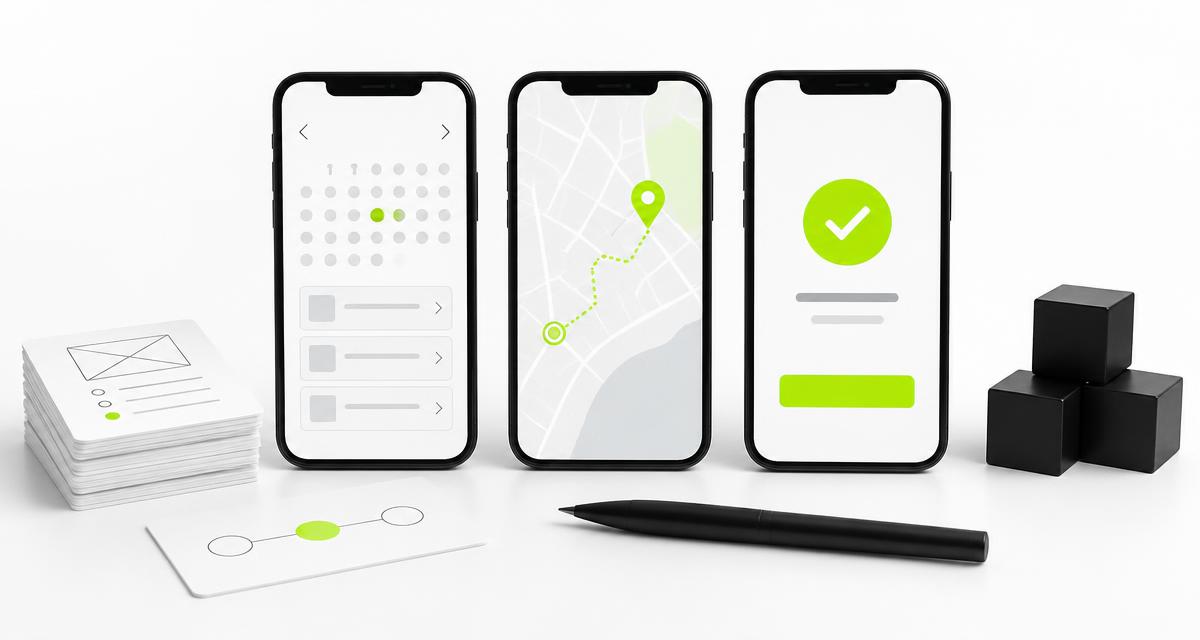
Mobile app development cost in India depends on the complete product: the app, the services behind it, the admin tools, testing, and launch responsibilities. A screen count alone cannot tell you what those pieces will cost.
A three-screen delivery tracker with live location and unreliable network conditions may involve more engineering than a larger catalogue app. Start with the customer journey and the business rules, then estimate the work required to support them.
What belongs in an app development budget?
Ask for a scope that separates the following workstreams:
- Product planning: user journeys, business rules, and acceptance criteria.
- Design: interface design, prototypes, and key interaction states.
- The mobile app: navigation, device features, local storage, and platform behaviour.
- Backend services: accounts, data, permissions, payments, and business logic.
- Admin tools: managing customers, bookings, content, refunds, or reports where needed.
- Testing: representative devices, operating systems, network conditions, and sensitive workflows.
- Launch: release configuration, store assets, review support, and handover.
Not every app needs every feature, but each exclusion should be deliberate. Ask whether the estimate includes project coordination and revisions so there is no double counting or unexpected omission.
A worked budgeting example in rupees
This is a hypothetical calculation, not an Indian market average or an NCC quotation. Suppose a narrowly scoped app project is estimated at 800 total hours across planning, design, mobile and backend development, testing, and deployment.
At an assumed blended rate of ₹2,000 per hour, the effort budget would be ₹16,00,000. An illustrative 10% allowance for identified uncertainty would add ₹1,60,000, producing a planning total of ₹17,60,000 before applicable taxes, third-party charges, and ongoing operations.
The 800 hours, rate, and allowance are demonstration inputs—not a promise that your app fits this budget. Ask your partner to show their actual work breakdown and assumptions. Different roles may have different rates, and calendar delivery time also depends on parallel work, reviews, and dependencies.
For a broader ownership-cost framework, see our custom software development cost guide.
Web app, cross-platform, or native?
A responsive web app may be appropriate when users mainly need forms, account access, dashboards, or a straightforward workflow in a browser. Check whether its device access and offline behaviour meet the actual requirements.
A cross-platform mobile app can share some implementation across iOS and Android. That may reduce duplicated work, but integrations, platform differences, and device testing still need attention.
Separate native apps may be justified by platform-specific requirements, specialised device behaviour, or performance constraints. Native is not automatically necessary for every product, and cross-platform is not automatically the cheapest overall.
Ask for the trade-offs in your use case. The relevant question is which approach supports the product reliably—not which technology is fashionable.
The features that can increase effort
Offline use and synchronisation
If users must work without a connection, define what is available offline and what happens when data changes on multiple devices. Conflict resolution and recovery need explicit rules.
Payments and refunds
Specify payment status, failure handling, duplicate attempts, refunds, and reconciliation. A successful checkout demonstration does not cover every real transaction state.
Location and notifications
Decide when location is needed, whether it runs in the background, and how users control permissions. Notifications need useful triggers and a fallback when they are not delivered or are disabled.
Multiple roles and operational tools
A customer app may also require provider, support, and administrator experiences. Those workflows are part of the product even when they are not visible in the customer’s screenshots.
Testing is more than checking the happy path
Agree a device and operating-system test scope. Include slow connections, expired sessions, denied permissions, payment failures, accessibility, and interrupted workflows where relevant.
For security planning, OWASP MASVS outlines mobile security controls. Its assessment guidance distinguishes mobile-client verification from testing remote services; both may matter to your app.
Ask who resolves findings and how testing evidence will be shared. Security should be scoped to the data and risks involved, not reduced to a generic badge.
Include launch and post-launch expenses
Clarify who owns the store accounts and provides screenshots, descriptions, privacy information, and review responses. Check current platform rules and charges when planning; submission is not a guarantee of approval on a particular date.
Recurring costs may include hosting, storage, maps, messages, payment processing, monitoring, and support. Operating-system changes and dependency updates may require maintenance even when you add no features.
Request usage scenarios and a support plan rather than relying on a universal annual maintenance percentage. Separate corrective maintenance from your roadmap for improvements.
How to make the first release smaller
Choose one valuable end-to-end journey. For a booking app, that might be finding a service, booking a slot, and receiving a confirmation, supported by enough admin capability to fulfil the booking.
Defer features that are not necessary to complete that journey. Do not defer essential access control, recovery, or transaction handling. A focused first release should still be usable and trustworthy.
If your idea is a services marketplace, also read our home services app development article to identify operational requirements beyond the customer interface.
What to send when requesting an app estimate
Share the target users, essential journey, desired platforms, existing systems, required device features, launch constraints, and budget range. Include who will manage the product after launch.
Next Code Company is based in Hyderabad. Discuss your mobile app idea with NCC to turn those requirements into a scope that can be estimated. For partner evaluation, use our software company selection checklist.
Published October 11, 2026. All numerical examples are illustrative and exclude applicable taxes and recurring charges.
Related articles
Have a story worth engineering?
We turn strategy into shipped software. Book a free consultation and we'll map the build, the timeline and the cost.