
Custom Software Development Cost in India: A Business Owner’s Guide
Understand custom software development costs in India, from business automation tools and CRM systems to ERP platforms and SaaS products. Explore pricing factors, development timelines, hidden expenses, and practical ways to plan your software budget.
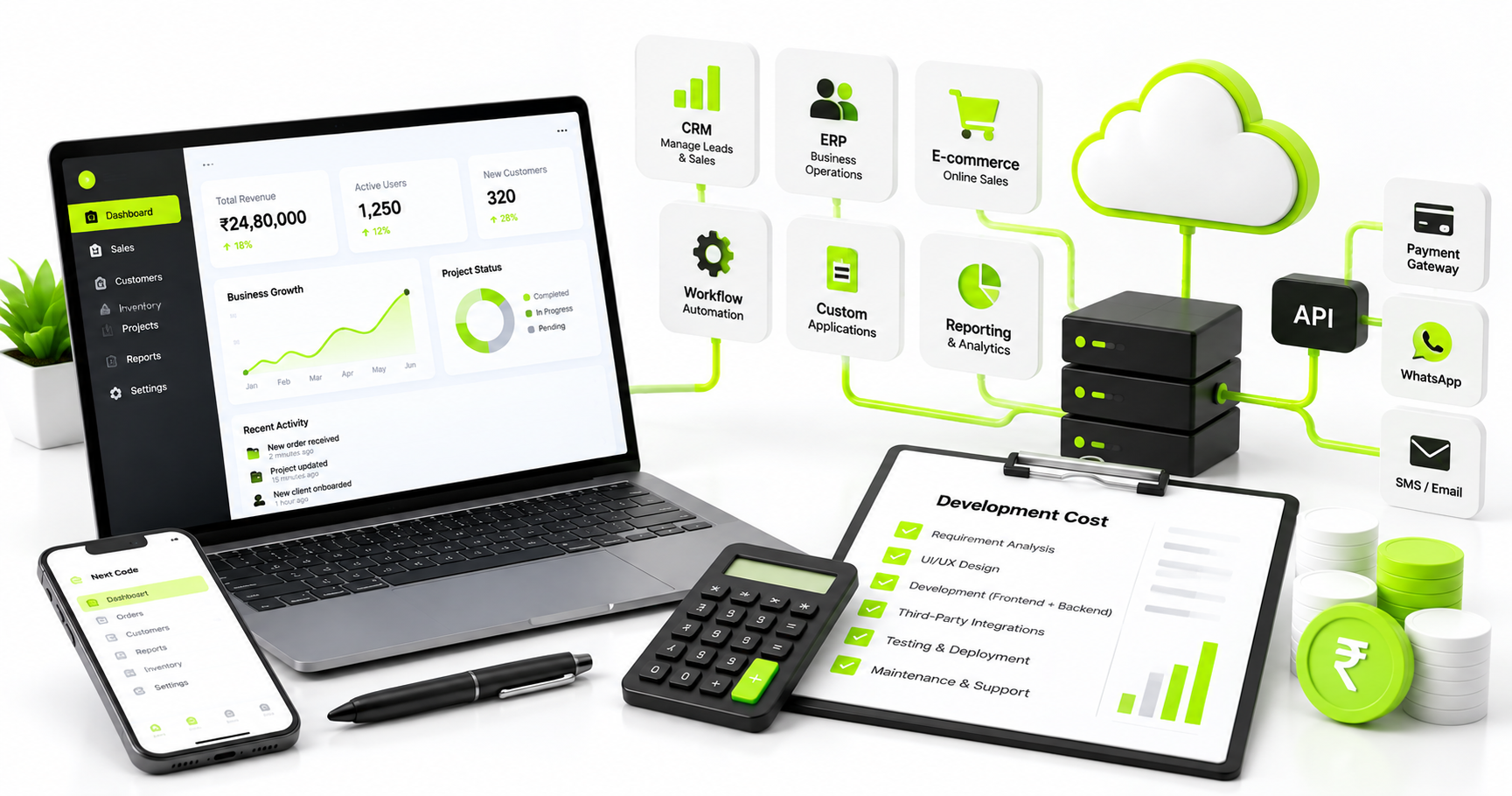
Custom software development costs in India depend on the business problem, the features required, the complexity of the workflows, and the systems the software must connect with. A simple internal management tool may require a relatively small investment, while a customised CRM, ERP, SaaS platform, or multi-department business application can require a substantially larger budget.
For business owners, the challenge is not simply finding the cheapest developer. It is understanding what the proposed software will deliver, which expenses are included, and how the product will support the business after launch.
This guide explains the main factors influencing custom software development costs in India, indicative project budgets, common additional expenses, development timelines, and practical ways to plan your investment.
What is custom software development?
Custom software is an application designed and developed around the specific requirements of a business, rather than relying entirely on a ready-made product.
Businesses may use custom software to manage sales, automate repetitive work, track inventory, process orders, coordinate employees, generate reports, or connect different departments through a single system.
Common examples include:
- Customer relationship management (CRM) systems.
- Enterprise resource planning (ERP) applications.
- Inventory, warehouse, and order management software.
- Custom e-commerce and multi-vendor marketplaces.
- HR, payroll, attendance, and employee management systems.
- Booking, delivery, and logistics platforms.
- SaaS products developed for subscription-based customers.
- Business dashboards, workflow automation, and reporting tools.
The right solution depends on your existing processes, the limitations of your current tools, and the outcomes you want to achieve.
How much does custom software development cost in India?
There is no universal price for custom software. The budget depends on the number of modules, user roles, integrations, security requirements, reporting capabilities, and the amount of custom engineering involved.
The following figures are illustrative planning ranges for professionally developed software projects in India. They are not verified market averages or fixed quotations, and individual projects may fall outside these ranges.
| Software type | Indicative development budget | Typical scope |
|---|---|---|
| Basic internal business tool | ₹1.5 lakh–₹4 lakh | Forms, simple records, and basic reporting |
| Workflow automation system | ₹3 lakh–₹8 lakh | Approvals, notifications, task management, and business rules |
| Custom CRM | ₹4 lakh–₹12 lakh | Leads, sales pipelines, customer records, and reports |
| Inventory or order management system | ₹4 lakh–₹15 lakh | Stock tracking, orders, users, and operational dashboards |
| Custom ERP platform | ₹10 lakh–₹30 lakh+ | Multiple departments, permissions, financial workflows, and integrations |
| SaaS or multi-tenant platform | ₹10 lakh–₹35 lakh+ | Customer accounts, subscriptions, billing, administration, and scalable architecture |
| Complex enterprise software | ₹25 lakh–₹50 lakh+ | Advanced integrations, complex workflows, and enterprise requirements |
These estimates assume different scopes and are not directly comparable without a feature-by-feature assessment. A small CRM with a few screens is different from a complete sales platform with automation, telephony, multiple permissions, and advanced analytics.
Request a detailed proposal based on your actual requirements before using any range to approve a project budget.
What factors influence custom software development costs?
1. Features and business requirements
Features are one of the biggest factors affecting development effort. A system that records customer details is generally less complex than one that manages quotations, approvals, payments, inventory, and automated notifications.
Every additional feature may require interface design, backend logic, database changes, permissions, testing, and documentation.
Before development begins, separate your requirements into three groups:
- Essential: Features required for the software to solve the primary business problem.
- Important: Features that improve efficiency but can follow the first release.
- Future enhancements: Advanced capabilities that should be considered after the initial product has been validated.
This prioritisation helps you avoid spending money on functionality your team may not need immediately.
2. Number of users, roles, and departments
A simple application for one team may need only a few access levels. A larger business platform may require separate permissions for administrators, managers, sales teams, finance departments, warehouse employees, and external customers.
Each role may have different dashboards, approval rules, data visibility, and reporting requirements. These differences add implementation and testing effort.
Explain your organisational structure to the development team early so that permissions and workflows can be planned correctly.
3. UI/UX design and usability
Custom software should make daily work easier rather than introducing unnecessary complexity. A clear interface can help employees complete tasks faster and reduce errors.
Design requirements may include wireframes, interactive prototypes, responsive layouts, dashboards, charts, and different interfaces for desktop and mobile users.
Ask whether design is included in the proposal and how many review rounds are covered. Approving the core workflows before full development can reduce expensive changes later.
4. Backend development and database architecture
The backend manages the business logic, data storage, authentication, integrations, and communication between users and the application.
A basic record-management tool may require a straightforward database. A multi-branch ERP or marketplace may need more complex data relationships, transaction handling, reporting, and synchronisation.
Discuss how the proposed architecture will support your current needs and expected growth. The objective is to build a reliable system without paying for unnecessary infrastructure or complexity.
5. Third-party integrations
Many businesses already use accounting software, payment gateways, email platforms, CRMs, e-commerce websites, or communication tools. Connecting these systems can save manual effort, but integration work must be included in the project scope.
Examples include:
- Payment gateways such as Razorpay and Cashfree.
- WhatsApp Business messaging and notification services.
- Accounting and invoicing platforms.
- Shipping, logistics, and delivery services.
- Google Maps and location services.
- CRM, ERP, and inventory APIs.
- AI services and document-processing APIs.
Some providers charge recurring fees or usage-based charges. Confirm API availability, account requirements, rate limits, and subscription costs before finalising the development budget.
6. Security, testing, and compliance
Business software may store customer information, employee records, financial data, or commercially sensitive information. The required security measures should reflect the data being processed and the consequences of unauthorised access.
Development and testing may include role-based permissions, secure authentication, input validation, audit logs, backup procedures, vulnerability checks, and recovery testing.
Projects subject to specific legal or regulatory requirements may also need additional documentation, controls, or independent assessments. Clarify these requirements before accepting a quotation.
Custom software vs ready-made software: Which is more cost-effective?
Custom development is not always the best choice. The decision depends on whether an existing product can meet your business requirements without expensive workarounds.
| Factor | Ready-made software | Custom software |
|---|---|---|
| Initial investment | Often lower | Usually higher |
| Time to start | Often faster | Requires a development cycle |
| Custom workflows | Limited by product capabilities | Designed around your requirements |
| Integrations | Depends on available connectors | Can be built for specific systems |
| Ongoing expenses | Subscriptions and add-ons may apply | Hosting, maintenance, and enhancement costs apply |
| Control over development | Depends on the vendor | Depends on your contract and ownership arrangements |
A ready-made CRM or accounting system may be sufficient when your processes are standard. Custom software may be worth considering when existing products cannot support important workflows, integrations, or business requirements.
Compare the total cost over several years rather than considering only the initial purchase or development price.
How much does CRM, ERP, and SaaS development cost?
CRM software development
A custom CRM can manage leads, contacts, follow-ups, sales pipelines, quotations, customer communication, and performance reports.
The cost depends on whether you need a simple lead tracker or a larger system with automated workflows, telephony, WhatsApp integrations, team permissions, and advanced analytics.
Start by documenting your sales process and identifying where the existing system creates delays, duplicate work, or missed follow-ups.
ERP software development
An ERP system connects business operations such as inventory, procurement, finance, sales, HR, and reporting.
ERP development can become more complex because departments share data and depend on consistent business rules. A change in inventory, for example, may affect purchasing, order processing, and financial records.
Consider implementing the highest-priority modules first and expanding after the core workflows are stable.
SaaS product development
A SaaS product allows customers to access software through a subscription or another commercial model. In addition to core features, it may require customer onboarding, subscription management, billing, tenant separation, usage limits, administration, and product analytics.
Multi-tenant architecture, access isolation, payment integration, and ongoing infrastructure management can affect the cost significantly.
If you are launching a SaaS startup, begin with the smallest product that solves a specific customer problem. Validate demand before investing in a large collection of advanced features.
What additional costs should you consider?
The initial development quotation does not always represent the total cost of owning business software. Include ongoing operating expenses in your budget.
- Hosting and infrastructure: Cloud servers, databases, file storage, backups, and monitoring.
- Third-party subscriptions: Payment services, messaging APIs, AI APIs, and external software licences.
- Maintenance and updates: Bug fixes, security patches, dependency updates, and compatibility improvements.
- Support and monitoring: Incident investigation, operational support, and performance monitoring.
- New features: Additional modules and changes introduced after the agreed scope.
- Data migration: Moving existing records from spreadsheets, legacy systems, or other applications.
- Training and documentation: Helping employees adopt the new system and understand its workflows.
- Taxes and commercial charges: Confirm applicable GST and other charges in the proposal.
Ask your development partner to distinguish one-time project expenses from recurring operating costs. This provides a more realistic picture of the first-year budget and the longer-term cost of ownership.
How long does custom software development take?
Timelines depend on the complexity of the product, the availability of requirements, the development team's capacity, integrations, and the time required for testing and approvals.
- Basic business tool: May take several weeks for a tightly defined scope.
- Workflow automation or small CRM: May take around one to three months.
- Business management platform: May require several months depending on the number of modules and integrations.
- Complex ERP or SaaS product: May require several months or longer, particularly when multiple teams, data migrations, or complex workflows are involved.
These are broad planning estimates, not guaranteed delivery schedules. Ask for milestones covering requirements, design, development, testing, deployment, and handover.
How can you reduce software development costs?
Reducing costs should mean removing unnecessary work, not skipping essential engineering or security measures.
- Start with a clear problem: Define what the software must improve before discussing features.
- Build an MVP: Launch the smallest useful version that supports your core workflow.
- Prioritise requirements: Separate essential features from future enhancements.
- Reuse existing systems: Where appropriate, integrate existing databases, APIs, and tools rather than rebuilding everything.
- Approve workflows early: Confirm user journeys and design before implementation progresses.
- Compare equivalent proposals: Ensure quotations cover the same deliverables, testing, and deployment responsibilities.
- Plan for maintainability: Request documentation, clear architecture, and appropriate testing.
- Control scope changes: Agree on how new requests affect cost and delivery dates.
A phased approach lets you invest in proven requirements first and use feedback from actual users to guide later development.
How to choose a custom software development company
Choosing a development partner requires more than comparing prices. You need a team that understands your business processes, communicates clearly, and can explain how the product will be developed, tested, deployed, and maintained.
Before signing an agreement, evaluate:
- Relevant experience with comparable business workflows.
- A clear scope of work and written acceptance criteria.
- The proposed team and individual responsibilities.
- Transparent pricing, milestones, exclusions, and change-request terms.
- Security, testing, deployment, and backup arrangements.
- Source-code ownership and access to production accounts.
- Documentation, training, and post-launch support.
Ask for demonstrations or case studies that show what the team actually delivered. Ensure that ownership and exit arrangements are clearly documented in the contract.
Explore Next Code Company's portfolio and case studies to understand relevant project experience. If you are planning a business management system, CRM, ERP, SaaS product, or workflow automation solution, discuss your software requirements with NCC.
Frequently asked questions
What is the minimum cost of custom software development in India?
The minimum depends on the scope, features, design, and backend requirements. A small, tightly scoped internal tool may require a relatively modest investment, while a production-ready system with integrations, permissions, and reporting will require more work. Obtain a detailed estimate based on your actual requirements.
Is custom software better than Excel?
Not always. Excel may be sufficient for simple calculations, small datasets, and individual workflows. Custom software becomes worth considering when multiple employees need shared records, controlled permissions, reliable audit trails, integrated workflows, or automated reporting that spreadsheets cannot support effectively.
How much does it cost to build a custom CRM in India?
The budget depends on the features, user roles, integrations, automation, and reporting requirements. A basic lead management tool is significantly different from a complete CRM with communication integrations, advanced permissions, and sales analytics.
Who owns the source code of custom software?
Ownership depends on the contract, applicable law, and the rights associated with third-party components and reusable code. Define ownership, licensing, repository access, documentation, and handover obligations in writing before development begins.
Can custom software integrate with an existing website?
Yes, if the website exposes suitable APIs or the systems can be connected through an appropriate integration layer. The implementation depends on the existing architecture, authentication, data structures, and synchronisation requirements.
What is the difference between development cost and maintenance cost?
Development cost covers the agreed work to build and deliver the software. Maintenance typically covers agreed operational updates, defect fixes, security patches, and compatibility work. Hosting, third-party subscriptions, and new features may be billed separately.
Final thoughts
Custom software development is an investment in how your business operates. The right solution can connect systems, reduce repetitive work, improve visibility, and support growth, but the value depends on choosing the right scope and implementation approach.
Define the business problem, prioritise essential features, compare proposals on equal terms, and plan for ongoing costs before committing your budget. A well-defined first release provides a practical foundation for improving the product over time.
Next Code Company works with businesses to plan and develop software solutions around their operational requirements. Contact NCC to discuss your next software project.
Published October 11, 2026. Budget figures and timelines in this article are illustrative planning estimates, not verified market averages or a quotation. Actual costs depend on the final project scope and delivery requirements.
Related articles

Have a story worth engineering?
We turn strategy into shipped software. Book a free consultation and we'll map the build, the timeline and the cost.