
How Much Does It Cost to Build an E-commerce App in India?
Planning to launch an e-commerce app? Discover development costs in India, essential features, payment gateway integration, inventory management, delivery tracking, and the factors that influence your budget.
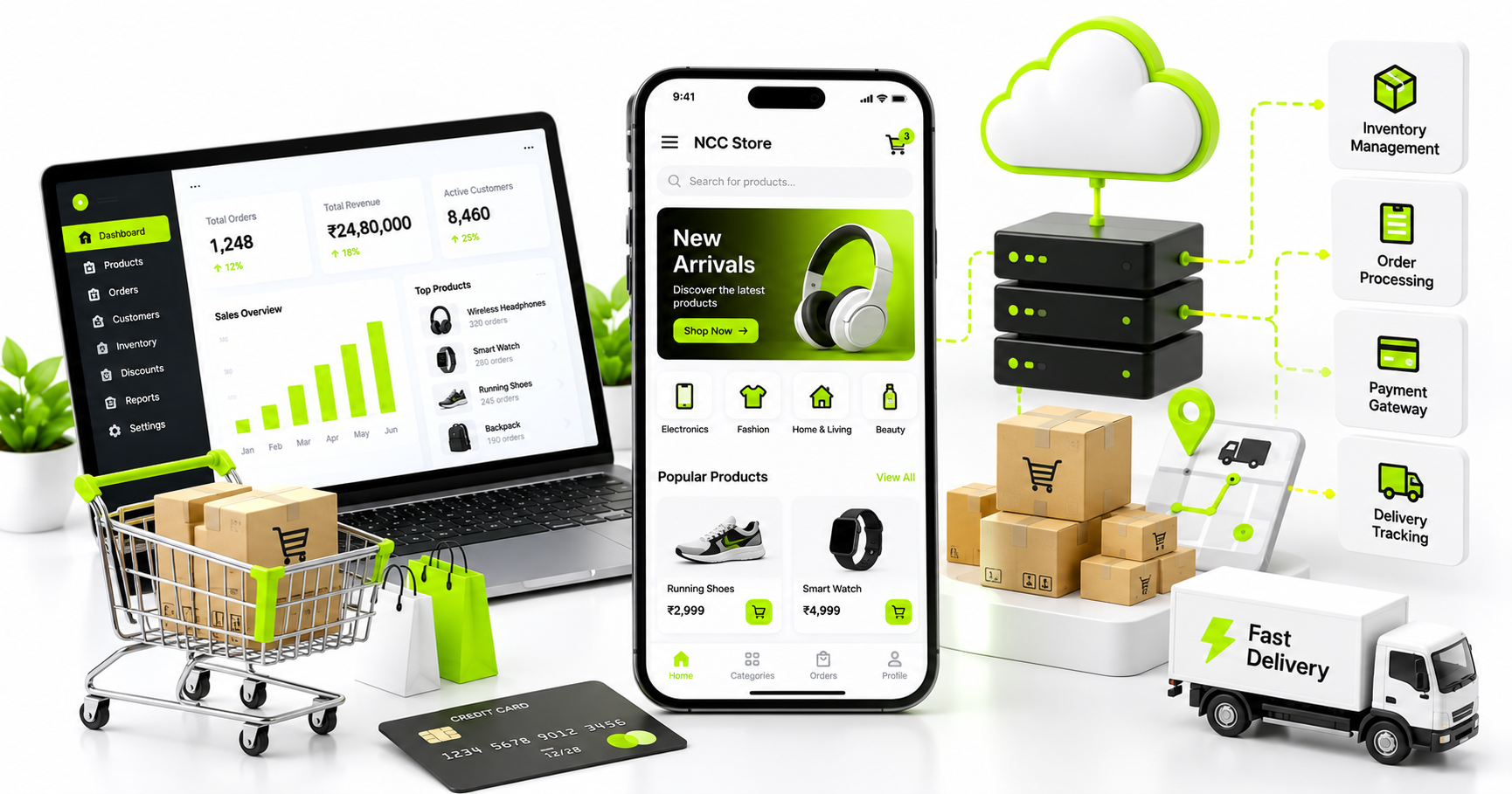
Building an e-commerce app in India can cost a few lakh rupees for a simple online shopping application and considerably more for a feature-rich platform with inventory management, payment integrations, delivery tracking, and multiple vendors. The final budget depends on the shopping experience you want to provide, the complexity of your backend, and how your business manages products, orders, customers, and deliveries.
If you already sell products through a website, you may be considering a mobile app to improve the customer experience. If you are starting a new business, you may need both a website and an app. Understanding the cost factors before development begins can help you choose the right approach.
This guide explains e-commerce app development costs in India, essential features, technology choices, ongoing expenses, and practical ways to launch without spending unnecessarily.
How much does e-commerce app development cost in India?
There is no fixed price for every online shopping app. A basic catalogue and ordering application requires less work than a platform with advanced search, discounts, inventory synchronisation, delivery tracking, vendor management, and customer support.
The following ranges are illustrative budgeting estimates for custom development in India. Actual costs depend on the scope, design, integrations, platforms, and delivery responsibilities.
| Application type | Indicative development budget | Typical features |
|---|---|---|
| Basic shopping app | ₹2 lakh–₹5 lakh | Product catalogue, product details, cart, and basic ordering |
| Small business e-commerce app | ₹4 lakh–₹8 lakh | Customer accounts, checkout, order history, and an admin panel |
| Full-featured e-commerce app | ₹8 lakh–₹15 lakh | Payments, inventory, coupons, notifications, and order management |
| Advanced commerce platform | ₹15 lakh–₹25 lakh+ | Complex integrations, advanced fulfilment, analytics, and multiple workflows |
| Multi-vendor marketplace | ₹12 lakh–₹30 lakh+ | Vendor onboarding, product listings, commissions, and marketplace administration |
These figures are planning estimates, not verified market averages or fixed quotations from Next Code Company. A simple application may cost less, while a large marketplace or enterprise commerce platform can exceed these ranges.
When comparing proposals, confirm whether the price includes Android and iOS apps, backend development, an admin dashboard, website integration, testing, deployment, and post-launch support.
What type of e-commerce app do you need?
1. Single-vendor online shopping app
A single-vendor application sells products from one business. The company controls the catalogue, prices, stock, orders, and customer relationships.
This model is suitable for manufacturers, retailers, direct-to-consumer brands, wholesalers, and businesses expanding an existing online store.
2. Multi-vendor marketplace app
A marketplace allows multiple sellers to list and sell products through a shared platform. In addition to customer-facing shopping features, it may require vendor registration, seller dashboards, commissions, order allocation, settlement tracking, and dispute management.
These additional workflows can increase development effort substantially. If you are launching a marketplace, define the responsibilities of customers, vendors, administrators, and delivery partners before estimating the budget.
3. Business-to-business e-commerce app
A B2B commerce application supports transactions between businesses. It may require bulk ordering, quantity-based pricing, customer-specific rates, credit terms, repeat orders, purchase approvals, and invoice management.
For wholesalers and distributors, these operational requirements can matter more than consumer-style animations or advanced visual effects.
Essential features that influence development cost
Customer registration and login
Customers may need registration, OTP verification, saved addresses, account management, and order history. The complexity depends on the authentication methods and account security requirements.
Product catalogue and search
The catalogue typically includes product images, descriptions, variants, prices, availability, categories, filters, and search. Large catalogues may need additional search optimisation, bulk import tools, and product data validation.
Shopping cart and checkout
The checkout process may include address selection, delivery options, discounts, taxes, shipping charges, payment selection, and order confirmation. A reliable checkout should handle failed payments and interrupted sessions without creating duplicate orders.
Payment gateway integration
Payment integrations may support UPI, cards, net banking, and other payment methods offered by the selected provider. Development should include payment-status verification, failure handling, refunds where required, and appropriate transaction records.
Providers such as Razorpay and Cashfree offer payment solutions for eligible businesses. Their transaction fees and service terms are separate from development charges and should be verified directly with the provider.
Inventory and order management
Inventory functionality helps businesses track available stock, product variants, order status, and stock changes. More complex systems may need warehouse-level inventory, low-stock alerts, purchase orders, and synchronisation with existing software.
If you already have an e-commerce website, the mobile app can often use the same product database and backend APIs. This avoids manually maintaining separate catalogues, provided both applications are designed to share the same source of truth.
Delivery and order tracking
Delivery features may include shipping integration, tracking links, delivery status updates, estimated delivery dates, and notifications. Advanced systems may need driver assignment, live location tracking, proof of delivery, and returns management.
The more delivery operations your business controls directly, the more backend logic and testing may be required.
Admin dashboard
An admin dashboard enables your team to manage products, prices, customers, orders, discounts, stock, and reports. Depending on your business model, separate permissions may be needed for sales staff, warehouse teams, customer support, and administrators.
Android vs iOS vs cross-platform development
Your platform strategy affects both the initial development budget and future maintenance effort.
- Android app: Suitable when you want to launch first on Android devices.
- iOS app: Appropriate when your customer base or business requirements justify a dedicated Apple-platform application.
- Cross-platform app: Frameworks such as Flutter can support Android and iOS through a shared codebase for much of the application.
Cross-platform development can reduce duplicated implementation work, but it does not eliminate platform-specific testing or integrations. The best option depends on your required features, performance needs, target customers, and long-term plans.
Should you build both a website and a mobile app?
Not every business needs to launch a website and mobile app at the same time. Your decision should depend on how customers discover your products, how frequently they purchase, and which channels support your sales strategy.
A responsive e-commerce website can be a practical starting point for businesses that need search visibility and a shareable product catalogue. A mobile app may become valuable when customers make repeat purchases, need order notifications, or benefit from account-specific features.
If you already have a functioning website, assess whether its backend can support a mobile application before rebuilding your systems.
With a suitable shared backend and APIs, the website and app can use the same product records, prices, stock availability, customer accounts, and order data. Updates made through the admin panel can then appear across both channels without duplicate product uploads.
How much does it cost to maintain an e-commerce app?
Development is only one part of the overall investment. After launch, you may need to pay for infrastructure, third-party services, maintenance, and enhancements.
- Hosting and database services: Depend on traffic, storage, product images, and infrastructure requirements.
- Payment gateway charges: Depend on the provider, transaction types, and applicable commercial terms.
- Shipping and delivery services: May involve per-shipment charges or separate subscriptions.
- SMS and notification services: Costs depend on usage and the selected provider.
- Maintenance and security: May cover bug fixes, dependency updates, security patches, and compatibility improvements.
- New features: Additional functionality may be charged separately from the original development scope.
- Marketing: Advertising, content production, customer acquisition, and promotional campaigns require separate budgets.
Ask your development partner for a separate estimate of recurring expenses. This helps you calculate the expected cost of operating the application after its initial release.
How long does it take to develop an e-commerce app?
Timelines depend on the number of features, supported platforms, integration complexity, data readiness, and testing requirements.
- Basic shopping app: May take several weeks for a tightly defined scope.
- Small business commerce app: May require around two to four months.
- Full-featured e-commerce platform: May take several months depending on integrations and operational requirements.
- Multi-vendor marketplace: May require several months or longer because of vendor workflows, commissions, order allocation, and settlements.
These are broad planning estimates, not guaranteed delivery dates. Ask for a milestone-based plan covering design, development, testing, deployment, and handover.
How to reduce e-commerce app development costs
You can manage your budget without sacrificing essential quality by focusing on the features that support your business model.
- Start with an MVP: Build the essential catalogue, cart, checkout, and order management features first.
- Reuse existing infrastructure: Evaluate whether your website, backend, database, and APIs can be reused.
- Prioritise integrations: Implement the essential payment, inventory, and shipping connections before adding optional services.
- Plan bulk product imports: If you manage a large catalogue, include spreadsheet or CSV import tools early.
- Define workflows clearly: Document product updates, stock changes, refunds, returns, and order fulfilment.
- Compare equivalent proposals: Ensure every company quotes against the same scope and deliverables.
- Test important customer journeys: Prioritise checkout, payment confirmation, stock accuracy, and order updates.
A phased release gives you an opportunity to learn from customers before investing in advanced personalisation, loyalty systems, or complex automation.
How to choose an e-commerce app development company
The right development partner should understand both the shopping experience and the operational systems behind it. A visually attractive app will not be enough if stock records are inaccurate, payments are unreliable, or order updates fail.
Before signing an agreement, ask the company:
- Have you developed comparable e-commerce or marketplace applications?
- Will the website and app share a common product database and backend?
- How will payments, stock updates, refunds, and order status changes work?
- Does the quotation include an admin panel and bulk product upload?
- Which platforms and devices will be supported?
- Who owns the source code and production accounts?
- What testing, deployment, maintenance, and support are included?
Compare written proposals, demonstrations, and relevant case studies rather than relying only on a quoted price.
Explore Next Code Company's portfolio and case studies to understand its digital product experience. If you are planning a shopping app, B2B commerce solution, or multi-vendor marketplace, discuss your e-commerce development project with NCC.
Frequently asked questions
What is the minimum cost to build an e-commerce app in India?
The minimum depends on the required features, platforms, and existing infrastructure. A basic catalogue and ordering app may need a smaller budget than a complete shopping platform with payments, inventory, delivery integrations, and an admin dashboard.
Can my existing website products appear in the mobile app?
Yes, provided the website and app connect to a compatible shared backend or product API. Product information, prices, stock, and orders can remain synchronised when both channels use the same data source and update rules.
Is Flutter suitable for e-commerce apps?
Flutter can be suitable for many shopping applications that need Android and iOS support. The decision depends on the required integrations, performance, platform-specific features, and the capabilities of the development team.
How much does a multi-vendor marketplace cost?
The budget depends on vendor onboarding, seller dashboards, commissions, payments, settlement workflows, returns, dispute handling, and administration. A marketplace with complex vendor operations will generally require more development effort than a single-store app.
Does e-commerce app development include a website?
Not necessarily. Some proposals cover only mobile applications, while others include a responsive website, shared backend, and admin panel. Confirm the exact deliverables and supported platforms in writing.
How do I manage thousands of products in my app?
A bulk product import tool can help you upload catalogue data from a structured CSV or spreadsheet, subject to the system's supported format. For large catalogues, also plan for image handling, variant validation, duplicate detection, stock updates, and error reporting.
Final thoughts
The cost of building an e-commerce app in India depends on the business model, shopping features, integrations, and operational complexity. A focused first release may be enough for a small online store, while a marketplace or B2B platform may require more extensive workflows and infrastructure.
Define your requirements, assess your existing website and backend, and compare proposals using the same scope. Plan for hosting, maintenance, payment services, and customer acquisition as well as initial development.
Next Code Company works with businesses to plan and develop digital products around their requirements. Contact NCC to discuss your e-commerce app idea.
Published October 11, 2026. Cost figures and timelines are illustrative planning estimates, not verified market averages or a quotation. Actual requirements and costs vary by project.
Related articles

Have a story worth engineering?
We turn strategy into shipped software. Book a free consultation and we'll map the build, the timeline and the cost.