
How to Build a SaaS Product: From Business Idea to Launch
Planning to build a SaaS product? Learn how to validate your idea, choose the right technology, plan essential features, estimate development costs, and launch a scalable subscription-based software business.
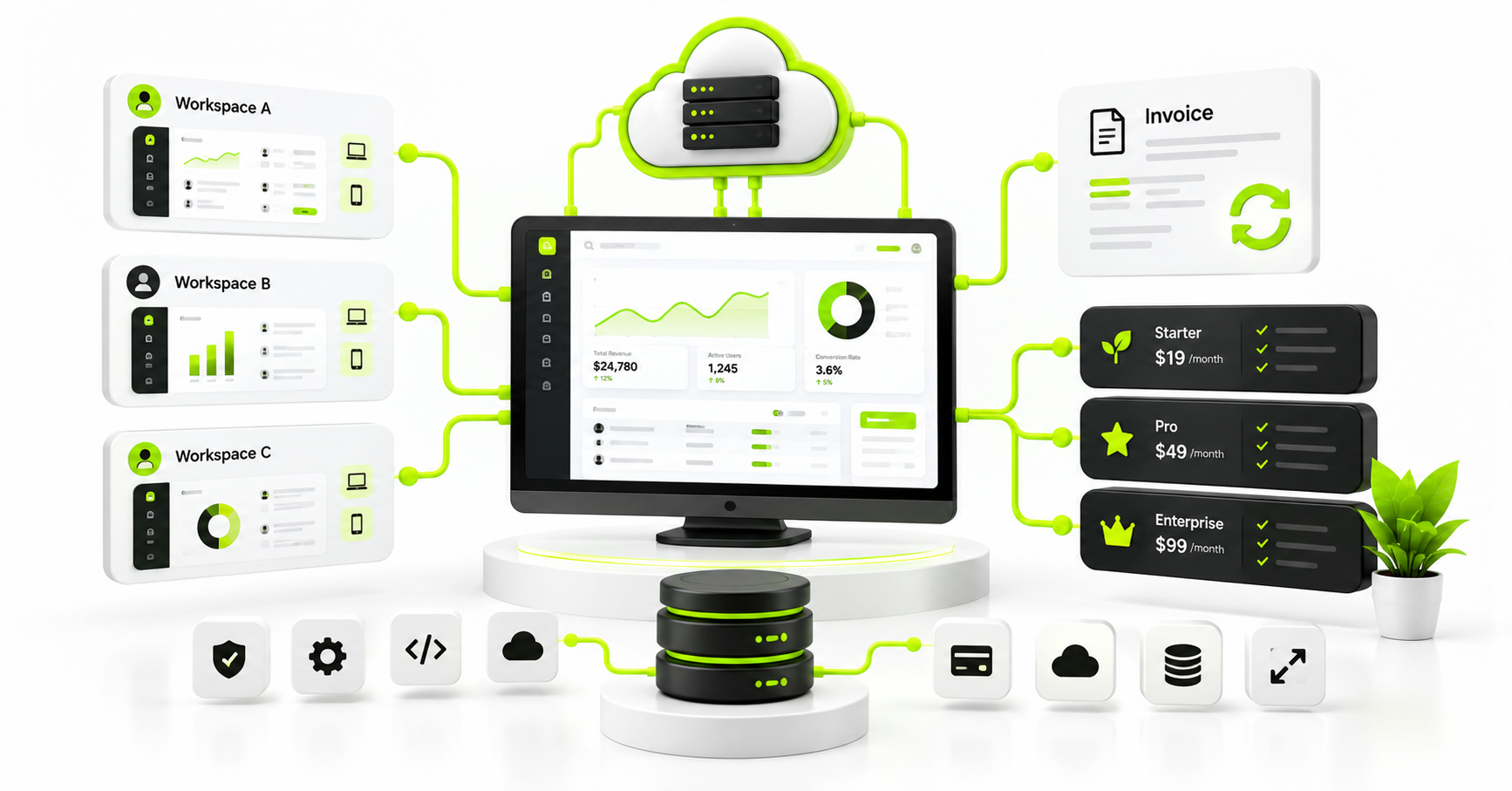
Building a successful SaaS product starts with solving a specific customer problem, not simply developing software and adding a subscription payment option. A sustainable Software as a Service business needs a clear target audience, a useful product, reliable technology, an appropriate pricing model, and a plan for acquiring and retaining customers.
Whether you are a startup founder developing a new software idea or an established business turning an internal tool into a commercial product, the decisions you make before development can influence your costs, launch timeline, and ability to grow.
This guide explains how to build a SaaS product from idea validation to launch, including essential features, technology choices, development costs, subscription management, and long-term scalability.
What is a SaaS product?
Software as a Service (SaaS) is a software delivery model in which customers access an application over the internet, typically through a subscription or usage-based payment arrangement.
Instead of installing and maintaining the entire system independently, customers generally use software managed by the provider. The provider is responsible for the agreed hosting, updates, infrastructure, and service operations.
Examples of SaaS products include:
- Customer relationship management platforms.
- Accounting and invoicing software.
- Project management and collaboration tools.
- Marketing automation platforms.
- Inventory and business management systems.
- Appointment booking and customer management software.
- AI-powered productivity and workflow tools.
A SaaS product can target individual consumers, small businesses, or large enterprises. Its architecture, pricing, onboarding, and support requirements should reflect the intended customer segment.
Step 1: Identify a real business problem
Start by identifying a problem that customers experience frequently and are motivated to solve. A product idea becomes more commercially promising when it addresses a clear need for a defined audience.
For example, a service business may struggle to coordinate appointments, payments, customer records, and employee schedules across multiple spreadsheets. A SaaS product could bring those workflows into one system.
Before building anything, ask:
- Who experiences the problem?
- How do they solve it today?
- What is inefficient, expensive, or frustrating about the current approach?
- How frequently does the problem occur?
- Would customers pay for a better solution?
Interview potential customers, examine existing alternatives, and test whether the problem is important enough to justify a new product. Positive feedback is useful, but actual willingness to pay provides stronger evidence of commercial demand.
Step 2: Validate your SaaS idea before development
One of the most expensive mistakes is building a large application before confirming that the intended audience needs it.
You can validate a SaaS idea through customer interviews, landing pages, product demonstrations, prototypes, or a limited pilot with early users.
For example, if you want to build a subscription-based CRM for small businesses, first identify which workflows existing tools fail to support. Show potential customers a prototype of the proposed solution and ask whether they would use it and what they would pay for.
Validation helps you identify the features that matter most before investing in full-scale engineering.
Step 3: Define the SaaS MVP
A minimum viable product (MVP) is an initial version containing enough functionality to deliver value to early customers and test your main business assumptions.
Your first release does not need every feature you eventually want to offer. It should solve the primary problem reliably.
Depending on your product, an MVP may include:
- User registration and authentication.
- A core dashboard or workspace.
- The primary business workflow.
- Data storage and management.
- Basic user permissions.
- Subscription or payment functionality, if required for the pilot.
- Essential notifications and administrative controls.
Advanced analytics, complex automation, extensive integrations, and custom reporting can often be introduced after the core product has been validated.
Prioritise features based on customer value, implementation effort, and the risks they help you test.
Step 4: Choose the right SaaS technology stack
The technology stack should support the product's functionality, security requirements, team expertise, and expected growth. There is no single stack that is best for every SaaS business.
A typical SaaS architecture may include:
- Frontend: React, Next.js, or another suitable web framework for the customer interface.
- Backend: Node.js, Laravel, or another framework for business logic and APIs.
- Database: PostgreSQL or another database suited to the application's data model.
- Authentication: A suitable identity system for registration, login, and account recovery.
- Cloud infrastructure: Hosting, storage, monitoring, and backup services.
- Payments: A payment provider that supports the intended markets and subscription model.
The best choice depends on your application. A small SaaS MVP may not need a complex microservices architecture. Starting with a well-structured, maintainable system can reduce unnecessary operational overhead.
Step 5: Plan SaaS architecture and customer workspaces
Many SaaS products serve multiple businesses through a single application. This is commonly known as a multi-tenant architecture.
Each customer may have their own users, records, settings, permissions, and subscription plan. The system must keep each customer's data appropriately separated and prevent unauthorised access across accounts.
Common architectural approaches include:
- Shared database and shared tables: Multiple customers use the same database structure, with appropriate tenant identifiers and access controls.
- Separate schemas or databases: Customer data is separated at a different database level, depending on the design.
The appropriate approach depends on security requirements, operational complexity, customer expectations, and the scale of the product.
Plan tenant isolation, access permissions, backups, auditability, and data deletion from the beginning. Retrofitting these controls into an established SaaS product can be more difficult than designing them into the initial architecture.
Step 6: Build subscription and billing management
Subscription management is a core part of many SaaS business models. The system needs to understand which customers have access to which features and how their subscriptions change over time.
Depending on your pricing model, billing functionality may include:
- Free trials and paid plans.
- Monthly or annual subscriptions.
- Plan upgrades and downgrades.
- Usage limits and feature restrictions.
- Payment status and failed-payment handling.
- Invoices, receipts, and billing history.
- Cancellation and subscription renewal workflows.
For example, a SaaS CRM might offer a starter plan for small teams and higher plans with additional users, automation, or reporting. The application should enforce the agreed limits consistently across the interface and backend.
Choose a payment provider based on supported countries, recurring billing capabilities, fees, tax requirements, and the payment methods your customers prefer. Subscription billing rules and payment integrations should be tested carefully before launch.
Step 7: Design an onboarding experience customers can understand
Even useful software can struggle if new customers cannot understand how to get started.
A good onboarding flow should help users create an account, configure their workspace, complete their first important task, and understand the value of the product.
Consider including:
- A simple registration and login process.
- Clear setup instructions.
- Sample data or guided demonstrations where appropriate.
- Helpful empty states and contextual guidance.
- Documentation and support access.
Measure how many users complete onboarding and reach the product's main value point. These insights can help you identify where customers are getting stuck.
Step 8: Estimate SaaS product development cost
SaaS development costs depend on the product's scope, architecture, integrations, security requirements, and operational complexity.
The following are illustrative budgeting ranges for custom software projects in India, not verified market averages or fixed quotations.
| Project type | Indicative development budget | Typical scope |
|---|---|---|
| Basic SaaS MVP | ₹3 lakh–₹8 lakh | Core workflow, accounts, dashboard, and basic data management |
| Subscription-based business application | ₹6 lakh–₹15 lakh | Multiple plans, billing integration, user permissions, and administration |
| Multi-tenant SaaS platform | ₹10 lakh–₹25 lakh+ | Tenant isolation, plan management, onboarding, and reporting |
| Advanced SaaS product | ₹20 lakh–₹40 lakh+ | Complex workflows, extensive integrations, advanced analytics, and higher operational requirements |
The ranges overlap because the scope of SaaS products varies considerably. A simple single-workflow product can be less expensive than a large platform with advanced permissions, automation, billing rules, and multiple integrations.
Ask for a detailed estimate that separates discovery, design, frontend development, backend development, integrations, testing, deployment, and support.
Step 9: Test security, reliability, and performance
SaaS products often store business-critical information. Security and reliability should therefore be part of the development process rather than tasks postponed until after launch.
Important areas include:
- Authentication and account recovery.
- Tenant isolation and role-based access.
- Secure API communication and input validation.
- Dependency updates and vulnerability handling.
- Database backups and recovery procedures.
- Error monitoring and operational logging.
- Performance under realistic workloads.
Test what happens when a payment fails, a subscription expires, a user loses access, or a customer attempts to access another tenant's records. These scenarios can be just as important as the main happy path.
Step 10: Launch, measure, and improve
Launching the SaaS product is the beginning of the customer feedback cycle, not the end of development.
Track metrics that reflect both product value and business sustainability, such as:
- New registrations and activation rates.
- Trial-to-paid conversion.
- Customer retention and churn.
- Monthly recurring revenue (MRR).
- Feature adoption and engagement.
- Support requests and common usability problems.
Use these measurements to identify which improvements are most likely to help customers succeed and the business grow. Avoid adding features solely because competitors have them.
Common mistakes to avoid when building a SaaS product
- Building too much too early: Large initial scopes increase cost before customer demand is proven.
- Ignoring customer validation: A technically impressive product may still fail to solve a problem customers will pay to fix.
- Underestimating security: Weak access controls and tenant isolation can put customer data at risk.
- Choosing technology without a reason: Popularity alone does not establish suitability.
- Ignoring operating costs: Hosting, support, payment fees, and external APIs affect long-term profitability.
- Neglecting onboarding: Customers may abandon a product if they cannot reach its main value quickly.
- Failing to plan maintenance: Software requires updates, monitoring, and ongoing improvements.
How to choose a SaaS development company
A suitable development partner should understand your target customers, explain the proposed architecture, and help you prioritise features around your business objectives.
Before signing an agreement, review the team's relevant experience, project milestones, testing process, ownership terms, documentation, and support arrangements.
Ask who will control the source-code repository, cloud accounts, database, domain, and third-party subscriptions. Confirm what happens if you later need to transfer the product to another team.
Explore Next Code Company's portfolio and case studies to assess relevant project experience. If you are planning a SaaS MVP, subscription platform, or custom business application, discuss your SaaS development project with NCC.
Frequently asked questions
How much does it cost to build a SaaS product in India?
The cost depends on the core features, subscription management, architecture, integrations, security requirements, and expected scale. A focused MVP generally requires less work than a multi-tenant platform with advanced billing and analytics. Obtain a scoped estimate before setting your budget.
How long does it take to build a SaaS application?
A focused MVP may take a few months, while a more complex platform can require several months or longer. The schedule depends on requirements, integrations, team capacity, testing, and customer feedback.
Can I start a SaaS business with an MVP?
Yes. An MVP can help validate customer demand before you invest in advanced functionality. It should still meet appropriate standards for security, reliability, and the intended use case.
Does every SaaS product need a multi-tenant architecture?
No. Multi-tenancy is common when one application serves multiple customers, but other architectures may suit particular security, isolation, or deployment requirements. Choose based on the product's needs.
Can a SaaS product support monthly and annual subscriptions?
Yes. The application and payment integration must support the relevant billing periods, renewals, plan changes, payment failures, cancellations, and access rules.
Can I turn an existing business tool into a SaaS product?
Potentially. The existing application needs to be assessed for customer separation, permissions, onboarding, subscription management, security, deployment, and support. An internal tool may require significant changes before it is suitable for external customers.
Final thoughts
Building a SaaS product requires a combination of customer research, thoughtful product planning, reliable engineering, and a sustainable commercial model.
Validate the problem, define a focused MVP, choose an appropriate architecture, and plan for subscriptions, security, support, and ongoing improvement. A smaller product that solves a real customer problem can provide a stronger foundation than a large application built without sufficient validation.
Next Code Company works with businesses to plan and develop software products around their requirements. Contact NCC to discuss your SaaS product idea.
Published October 11, 2026. Cost figures are illustrative planning estimates, not verified market averages or a quotation. Actual development costs and timelines depend on the final requirements.
Related articles

Have a story worth engineering?
We turn strategy into shipped software. Book a free consultation and we'll map the build, the timeline and the cost.