
How Much Does It Cost to Build a SaaS Product in India?
Discover how much it costs to build a SaaS product in India. Explore MVP budgets, subscription features, multi-tenant architecture, integrations, maintenance, and the factors that influence your development cost.
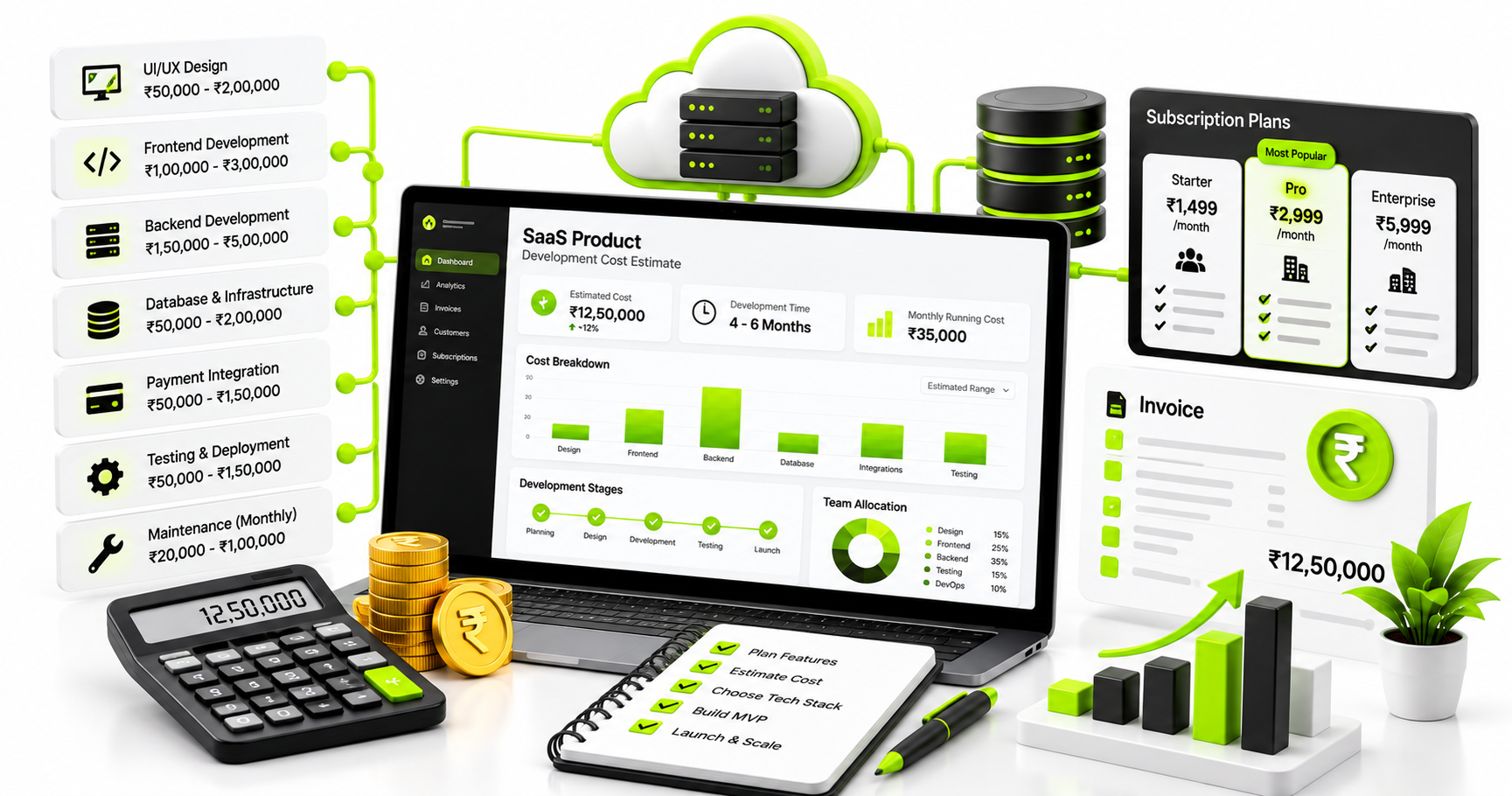
The cost of building a SaaS product in India can range from a few lakh rupees for a focused minimum viable product to several tens of lakhs for a feature-rich subscription platform. The actual budget depends on the product's functionality, customer account structure, billing requirements, integrations, security needs, and expected scale.
If you are planning to turn a business idea into subscription software, understanding these cost factors before development begins can help you prioritise features and avoid unnecessary expenditure.
This guide explains SaaS development costs in India, compares common project types, breaks down the main cost components, and covers the ongoing expenses you should consider before launching.
How much does SaaS development cost in India?
There is no single price for every SaaS application. A simple tool with user accounts and one core workflow requires less development effort than a multi-tenant platform with advanced permissions, recurring billing, reporting, integrations, and automation.
The following figures are illustrative budgeting estimates for custom development in India, not verified market averages or fixed quotations.
| SaaS product type | Indicative development budget | Typical scope |
|---|---|---|
| Basic SaaS MVP | ₹3 lakh–₹8 lakh | User accounts, dashboard, core workflow, and basic data management |
| Subscription-based business tool | ₹6 lakh–₹15 lakh | Billing integration, plans, access controls, and admin management |
| Multi-tenant SaaS platform | ₹10 lakh–₹25 lakh+ | Customer workspaces, tenant isolation, subscriptions, and reporting |
| Advanced SaaS application | ₹20 lakh–₹40 lakh+ | Complex workflows, advanced analytics, automation, and multiple integrations |
| Enterprise SaaS platform | ₹40 lakh and above | Extensive integrations, enterprise access controls, compliance requirements, and complex operations |
These ranges overlap because product requirements vary significantly. A relatively small application with demanding security or integration requirements may cost more than a larger application with straightforward workflows.
Ask development companies to estimate the same requirements so you can compare quotations fairly.
What factors affect SaaS development cost?
1. Product complexity
The number of features and the complexity of the workflows are major cost drivers. User registration, a dashboard, and a basic data-entry workflow are generally simpler than advanced automation, approval systems, analytics, or configurable business rules.
List your essential features separately from future enhancements. This helps your development team estimate the first release without including every long-term idea in the initial budget.
2. User roles and permissions
A SaaS application may support administrators, employees, managers, customers, or external partners. Each role may have different access permissions and responsibilities.
As these roles and permissions become more complex, the application requires additional design, implementation, and testing. Permission rules must be enforced by the backend, not only by hiding buttons in the interface.
3. Multi-tenant architecture
Many SaaS platforms serve multiple businesses through one application. Each customer may need a separate workspace, user list, settings, records, and subscription plan.
The architecture must prevent one customer from accessing another customer's information. Tenant isolation, role-based permissions, backups, and data management need to be designed and tested carefully.
A shared database can be suitable for some products, while other requirements may justify stronger separation. The right architecture depends on the security, operational, and contractual needs of the business.
4. Subscription and payment management
If your SaaS business charges recurring fees, you may need monthly and annual plans, free trials, upgrades, downgrades, cancellation workflows, invoices, and payment-failure handling.
Usage-based billing, metered features, promotional pricing, and complex subscription changes can add further development work.
Payment provider fees are separate from development charges. Confirm recurring billing support, settlement terms, refunds, and applicable charges directly with the selected provider.
5. Integrations and automation
Connecting your product to external services can increase development effort, especially when the integration involves complex data synchronisation or business rules.
Examples include CRM systems, accounting tools, email services, WhatsApp messaging, payment gateways, AI APIs, and reporting platforms.
For each integration, define what data moves between systems, which system is authoritative, how failures are handled, and whether the provider charges recurring fees.
6. UI/UX design
The interface affects how quickly customers understand and use your software. A straightforward dashboard has different design requirements from a product containing configurable workflows, complex reports, and multiple user roles.
Include wireframes, prototypes, responsive layouts, accessibility considerations, and usability testing in the project plan where appropriate.
SaaS development cost breakdown
Instead of evaluating the project using only one total price, request a breakdown of the main development activities.
| Cost component | What it covers |
|---|---|
| Discovery and planning | Requirements, workflows, technical planning, and scope definition |
| UI/UX design | Wireframes, prototypes, visual design, and responsive layouts |
| Frontend development | Customer dashboards, forms, navigation, and application interfaces |
| Backend development | Business logic, APIs, database operations, and permissions |
| Subscription management | Plans, billing rules, payment integration, and access entitlements |
| Integrations | Third-party services, synchronisation, and automation |
| Testing and security | Functional tests, access-control checks, performance tests, and fixes |
| Deployment and handover | Production setup, documentation, account access, and release preparation |
Not every project requires a separate charge for every item. The purpose of this breakdown is to make the scope, responsibilities, and exclusions clear.
How much does a SaaS MVP cost?
A minimum viable product (MVP) is an initial version that solves the primary customer problem and allows you to validate demand.
For example, a simple appointment-management SaaS might initially include:
- Business registration and login.
- A business dashboard.
- Appointment creation and management.
- Basic customer records.
- Email or in-app notifications.
- A simple administrative interface.
Features such as advanced analytics, multiple payment models, complex automation, and extensive third-party integrations can be added later if customers need them.
A focused MVP can help control the initial investment, but it should still include the security, data protection, and reliability appropriate to its intended use.
Monthly SaaS operating costs after launch
Your initial development budget is only one part of the financial plan. Once the product is live, you will need to operate the service and support customers.
- Cloud hosting and databases: Depend on infrastructure, storage, usage, and performance requirements.
- File and image storage: Depends on how much customer content the application stores.
- Email, SMS, and notifications: Depend on the selected providers and message volume.
- External APIs: May charge by request, usage, or subscription.
- Payment processing: Depends on the provider and transaction volume.
- Monitoring and backups: Support operational visibility and recovery.
- Maintenance and support: Cover agreed bug fixes, updates, and operational assistance.
- Customer acquisition: Includes marketing, sales, onboarding, and customer success activities.
These expenses vary widely by product and usage. Obtain estimates from your intended providers and model costs at several customer and usage levels rather than assuming that early-stage infrastructure costs will remain constant.
How to calculate SaaS pricing and break-even
Your subscription price should reflect the value customers receive, the market you serve, and the cost of operating the product.
For a simplified illustration, suppose your SaaS product charges ₹2,000 per month and has 50 paying customers.
- Monthly recurring revenue: ₹1,00,000.
- Annualised recurring revenue at the same rate: ₹12,00,000.
This is revenue, not profit. Hosting, support, salaries, payment fees, taxes, marketing, refunds, and other operating expenses must still be considered.
To estimate break-even, calculate your fixed monthly operating costs and the contribution remaining from each customer after variable costs. Divide fixed costs by the contribution per customer to estimate the number of paying customers needed to cover those costs.
Also account for customer churn, discounts, unpaid invoices, trial users, and the time required to acquire new customers. A subscription model is sustainable only when customer value and retention support the economics.
How to reduce SaaS development costs
You can control your initial investment without cutting essential quality by making deliberate scope and architecture decisions.
- Validate demand first: Confirm that the problem matters to your intended customers.
- Prioritise core workflows: Build the features needed to deliver the product's primary value.
- Reuse suitable services: Use established authentication, payment, and infrastructure services where they meet your requirements.
- Avoid premature complexity: Do not introduce microservices or elaborate infrastructure without a clear need.
- Define acceptance criteria: Specify what each feature must do before development begins.
- Plan integrations carefully: Build essential connections first and defer optional integrations.
- Test critical risks early: Validate tenant isolation, permissions, billing, and data handling before launch.
Reducing unnecessary scope is generally more sustainable than removing essential testing or security controls.
How long does it take to build a SaaS product?
A focused MVP may take a few months, while a more complex SaaS platform can require several months or longer. The actual timeline depends on the number of features, team size, integrations, data migration, testing, and decision-making speed.
Ask for milestones covering discovery, design, implementation, testing, deployment, and handover. Confirm which dependencies require your input and how changes to the scope will affect the schedule.
How to choose a SaaS development company
The right development partner should understand your business model, explain its technical recommendations, and provide a transparent plan for delivery and ongoing support.
Before signing, ask:
- What similar applications has the team delivered?
- How will customer data and tenant permissions be protected?
- Which subscription and billing workflows are included?
- What is included in the quotation and what is excluded?
- Who owns the source code and controls the production accounts?
- What testing, documentation, maintenance, and support are provided?
Review the proposed team, milestones, ownership terms, and exit arrangements. A low initial price is not necessarily the best value if essential functionality or support is excluded.
Explore Next Code Company's portfolio and case studies to assess relevant experience. If you are planning a SaaS MVP or subscription-based platform, discuss your SaaS development requirements with NCC.
Frequently asked questions
What is the minimum cost to build a SaaS product in India?
The budget depends on the product's features, architecture, integrations, and security requirements. A focused MVP can require a smaller investment than a multi-tenant platform with complex billing and automation. Obtain a project-specific quotation before committing to a budget.
Does SaaS development cost include hosting?
Not necessarily. Some proposals include initial infrastructure setup, while recurring hosting and third-party service charges are billed separately. Confirm the inclusions, usage limits, and ongoing operating costs in writing.
Is a custom SaaS product more expensive than using existing software?
Custom development generally requires an initial investment in design and engineering. Existing software may be cheaper to start with, but a custom product may be justified when your workflows, integrations, ownership requirements, or commercial opportunity cannot be addressed adequately by available tools.
How much should I budget for SaaS maintenance?
There is no universal percentage or fixed amount. Maintenance depends on the application's complexity, reliability requirements, infrastructure, update frequency, and support expectations. Request a separate maintenance estimate based on the expected workload.
Can I launch a SaaS product with a limited budget?
Yes, if you select a focused problem, validate customer demand, and limit the initial release to essential functionality. Ensure that the smaller scope still includes appropriate security, data protection, and operational controls.
Final thoughts
The cost of building a SaaS product in India depends on more than the number of screens or features. Architecture, billing workflows, customer isolation, integrations, security, and ongoing operations all influence the total investment.
Start with a validated business problem, define a focused MVP, and obtain a transparent estimate that separates development from recurring operating expenses. This approach helps you plan the launch budget and evaluate the long-term commercial potential of your product.
Next Code Company helps businesses plan and develop software products around their requirements. Contact NCC to discuss your SaaS product idea and development budget.
Published October 11, 2026. Cost ranges are illustrative planning estimates, not verified market averages or a quotation. Actual costs and timelines depend on the agreed project scope.
Related articles

Have a story worth engineering?
We turn strategy into shipped software. Book a free consultation and we'll map the build, the timeline and the cost.