
How to Choose a Mobile App Development Company That Understands Your Business
Choosing a mobile app development company involves more than checking portfolios and comparing prices. Learn how to evaluate business understanding, engineering expertise, technical planning, and the ability to turn your requirements into the right software solution.
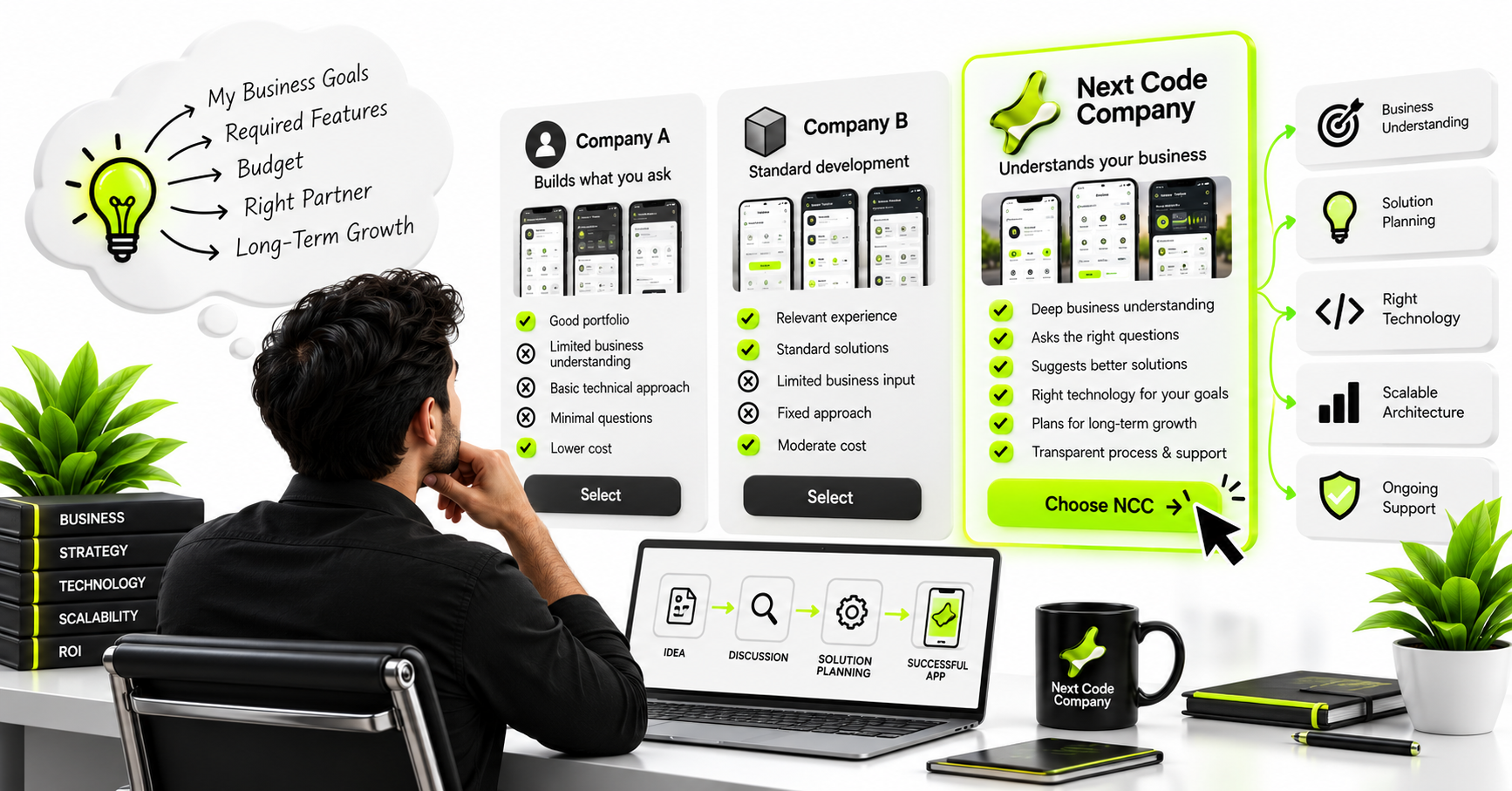
Choosing a mobile app development company should not begin and end with checking its portfolio. The more important question is whether the team can understand your business, identify what you actually need, and plan the right solution before development begins.
A portfolio can demonstrate previous experience. A list of technologies can demonstrate familiarity with tools. A competitive quotation can make a project appear affordable. However, none of these alone guarantees that a development partner will understand your requirements or make the right decisions for your business.
When you approach a software development expert, you are not simply looking for someone who can write code. You are looking for someone who can help translate a business problem into a practical, reliable, and maintainable software solution.
Whether you are planning a mobile application, a customer portal, an e-commerce platform, or an internal business management system, the quality of the thinking before development can influence the quality of the final product.
Why checking a portfolio is not enough
Reviewing previous projects is useful. It can help you understand a company's design capabilities, technical experience, and exposure to different industries. However, seeing that a company has built an application similar to yours does not necessarily establish how it will approach your specific requirements.
Two businesses may request the same type of application but have completely different operational needs.
For example, two companies might want a booking app. One may need simple appointment scheduling, while the other may require staff allocation, advance payments, cancellation rules, availability management, customer reminders, and reporting.
Both projects may look similar in a portfolio. The underlying business logic, however, can be very different.
Instead of asking only, "Have you built an app like this before?", also ask, "How would you understand our business and determine what this application needs to do?"
The difference between a developer who follows instructions and an engineer who thinks ahead
Software development involves more than implementing a list of features. It requires understanding why those features are needed, how they connect to business operations, and what consequences different technical decisions may have.
A task-focused approach may begin with the screens, buttons, and functions requested by the client. A business-oriented engineering approach begins by understanding the objective behind those requests.
| Area | Task-focused approach | Business-oriented engineering approach |
|---|---|---|
| Requirements | Records the requested features | Investigates the underlying business problem |
| Questions | Clarifies what needs to be built | Also asks why it is needed and what outcome it should achieve |
| Problem-solving | Implements the proposed solution | Evaluates alternative solutions and their trade-offs |
| Planning | Focuses on the immediate feature list | Considers dependencies, operational risks, and future changes |
| Cost decisions | Estimates the requested scope | Helps prioritise features and avoid unnecessary complexity |
| Success | Measures whether tasks are completed | Also considers whether the software solves the intended problem |
This is not a distinction between job titles. Developers can demonstrate excellent business understanding, and engineers can make poor decisions. What matters is the approach the person or company brings to your project.
A good development partner should understand your business before proposing a solution
Imagine that you run a delivery business and want an application to manage orders, drivers, and deliveries.
A superficial discussion might focus immediately on customer login, order forms, driver screens, maps, and notifications.
A deeper discussion would investigate how orders arrive, how drivers are assigned, how delivery fees are calculated, what happens when an order is delayed, how failed deliveries are handled, and how the business reconciles completed orders with payments.
These questions uncover the workflows that the software must support. Without that understanding, an application might look complete but still create extra work for the people who use it.
A capable development partner should explore:
- Business model: How does the company generate revenue and deliver value to customers?
- Users: Who will use the system, and what does each person need to accomplish?
- Current processes: How are tasks performed today, and where do delays or errors occur?
- Business rules: Which conditions, exceptions, approvals, and calculations must the software handle?
- Existing systems: Which tools, databases, payment services, or external platforms need to connect?
- Desired outcomes: What should improve once the software is implemented?
The answers provide a stronger foundation for deciding what to build and how to build it.
Look for someone who questions assumptions, not someone who agrees with everything
When discussing a software idea, you may already have a detailed list of features. That is a useful starting point, but it should not prevent the development team from examining whether those features are necessary or whether a better approach exists.
For example, you might request a separate mobile application for every user group. After understanding your workflows, an experienced team may recommend a shared backend with role-specific interfaces, or suggest starting with a responsive web application before investing in multiple mobile applications.
In another situation, you may request an advanced reporting module when the immediate problem could be solved with a simpler operational dashboard.
The right recommendation depends on your requirements. The important point is that the team should explain its reasoning instead of automatically accepting or rejecting your idea.
A good engineering partner should be able to explain:
- Which features are essential for the first release.
- Which features can be introduced later.
- Where a simpler approach could achieve the same outcome.
- Which assumptions need validation before development.
- Which decisions could create unnecessary costs or technical limitations.
The objective is not to challenge the client for the sake of it. It is to make better-informed decisions together.
Business thinking can prevent expensive development mistakes
Many software problems begin before the first line of code is written. Unclear requirements, missing workflows, unexamined dependencies, and unrealistic assumptions can lead to rework later.
Consider an e-commerce application. The initial feature list might include product listings, a shopping cart, and online payments. However, the business may also need stock reservation, order cancellation, refund processing, delivery updates, and reconciliation when a payment succeeds but an order update fails.
If these scenarios are not considered during planning, they can become costly changes during development or create operational problems after launch.
Thinking ahead means identifying important scenarios early, documenting decisions, and deciding which risks need to be addressed before release.
It does not mean predicting every possible future requirement. It means using experience and structured analysis to reduce avoidable surprises.
The right technology should follow the requirements
Technology is an important part of software development, but it should support the business solution rather than determine it by default.
A development company may specialise in particular frameworks or platforms. Those skills are valuable, but the team should still explain why its proposed approach fits your project.
For example, the decision between native and cross-platform mobile development may depend on device-specific functionality, performance requirements, available budget, development timelines, and long-term maintenance.
Similarly, a business application may not need a complex distributed architecture at launch. A well-structured system that meets current requirements and can evolve appropriately may be a better starting point.
Ask the team to explain the reasoning behind its technology choices, including the limitations, ongoing costs, integration requirements, and likely implications of future changes.
Understand how the team plans beyond the first release
Business requirements evolve. Customer expectations change, transaction volumes increase, and new integrations become necessary. Software should be designed with a sensible understanding of these possibilities.
However, planning for growth does not mean building every anticipated feature immediately.
A practical engineering plan should distinguish between what the business needs now and what it may need later. The team can then make proportionate decisions about architecture, data structures, integrations, and modularity without adding complexity that the project does not yet require.
Before approving the plan, discuss:
- How the application will handle the expected workload.
- How new features can be introduced and tested.
- How integrations and external dependencies will be managed.
- How data will be backed up and recovered.
- How security updates, maintenance, and support will be handled.
- How the business can access its code, data, and production accounts.
This gives you a clearer understanding of the software beyond the initial demonstration.
How to evaluate a development company's thinking during the first meeting
You do not need to assess a company's expertise based on claims alone. Pay attention to the questions its team asks and the clarity of its reasoning.
During your initial discussion, consider whether the team:
- Asks about your business model and the problem you want to solve.
- Explores how your existing processes work, including exceptions.
- Identifies missing information and states its assumptions clearly.
- Explains alternative solutions and the trade-offs involved.
- Prioritises the first release instead of automatically expanding the scope.
- Recognises technical, operational, and integration risks.
- Connects its recommendations to your business objectives.
- Explains what it still needs to learn before making a reliable commitment.
A team that asks thoughtful questions may not provide every answer in the first meeting. That is reasonable. Complex requirements need investigation, and an expert should be willing to acknowledge uncertainty rather than make unsupported promises.
Where does a portfolio fit into the decision?
A portfolio remains useful, but it should be one part of your evaluation rather than the entire selection process.
Use previous work to investigate the company's experience with relevant workflows, technologies, integrations, and delivery challenges. Ask what the team contributed, how decisions were made, and what responsibilities belonged to the client.
Then evaluate how the team approaches your specific requirements. A company with fewer directly comparable projects may still demonstrate strong analysis and engineering judgement, while a large portfolio alone cannot establish that a team is the right fit for your business.
Look at previous work and the quality of the current discussion together. Neither should replace a clear scope, realistic delivery plan, appropriate testing, and written contractual terms.
The Next Code Company approach: Understand first, engineer with purpose
At Next Code Company, our positioning is built around an important principle: software should be planned around the business problem it needs to solve.
We believe a development engagement should go beyond collecting a feature list. It should involve understanding the client's objectives, examining workflows, identifying dependencies, and evaluating practical ways to deliver the intended outcome.
That approach means discussing priorities before committing to scope, considering the operational realities behind requested features, and explaining technical decisions in terms that business stakeholders can understand.
It also means recognising that not every idea needs to be built immediately. A focused first release, informed by the business requirements, can be more useful than a large application filled with features that have not been properly prioritised.
Our goal is to help businesses make informed software decisions and develop solutions that fit their requirements, operational needs, and plans for growth.
Explore the Next Code Company portfolio and case studies to learn more about our work, then bring your own business challenge to the discussion.
Frequently asked questions
Is checking a software development company's portfolio enough?
No. A portfolio can demonstrate previous experience, but it cannot establish how well a company will understand your requirements. Evaluate its discovery process, business understanding, technical reasoning, delivery plan, testing practices, and contractual responsibilities as well.
What is the difference between a developer and a software engineer?
The titles can overlap significantly across organisations. Rather than relying on job titles, assess how the person approaches problem-solving, requirements analysis, system design, testing, maintainability, and the business context of the software.
Why should a software development company understand my business model?
Your business model influences user workflows, permissions, pricing rules, integrations, reporting, and operational requirements. Understanding these factors helps the team propose a solution that supports how your business actually works.
Should a development company challenge my requirements?
A good partner should question assumptions constructively, explain alternatives, and identify potential risks. The final decisions should be made collaboratively, with clear reasoning and an understanding of the business implications.
How can I tell whether a development team is thinking ahead?
Look for questions about exceptions, dependencies, security, future changes, operational responsibilities, and acceptance criteria. Ask the team to explain the reasoning behind its recommendations rather than simply presenting a list of features and a price.
Final thoughts
Choosing a mobile app development company is about more than finding someone who can build an application. It is about finding a partner who can understand your business, identify the real problem, evaluate possible solutions, and plan the engineering work accordingly.
A portfolio shows what a company has worked on. A detailed discussion reveals how it thinks. A clear proposal demonstrates how that thinking translates into scope, responsibilities, cost, and delivery.
Do not choose a software partner only because it can build your idea. Choose one that can understand your requirements, help refine your thinking, and explain how the proposed solution will serve your business.
If you are planning a mobile app, web platform, or custom business application, discuss your requirements with Next Code Company. Start with the business problem, and let the conversation establish what the right solution should look like.
Published October 15, 2026. This is a general buyer's guide, not a ranking of software development companies or a guarantee of project outcomes.
Related articles

Have a story worth engineering?
We turn strategy into shipped software. Book a free consultation and we'll map the build, the timeline and the cost.