SaaS vs Custom Software Development: Which Is Right for Your Business?
Comparing SaaS and custom software development? Understand the differences in cost, ownership, flexibility, integrations, security, and scalability to choose the right solution for your business.
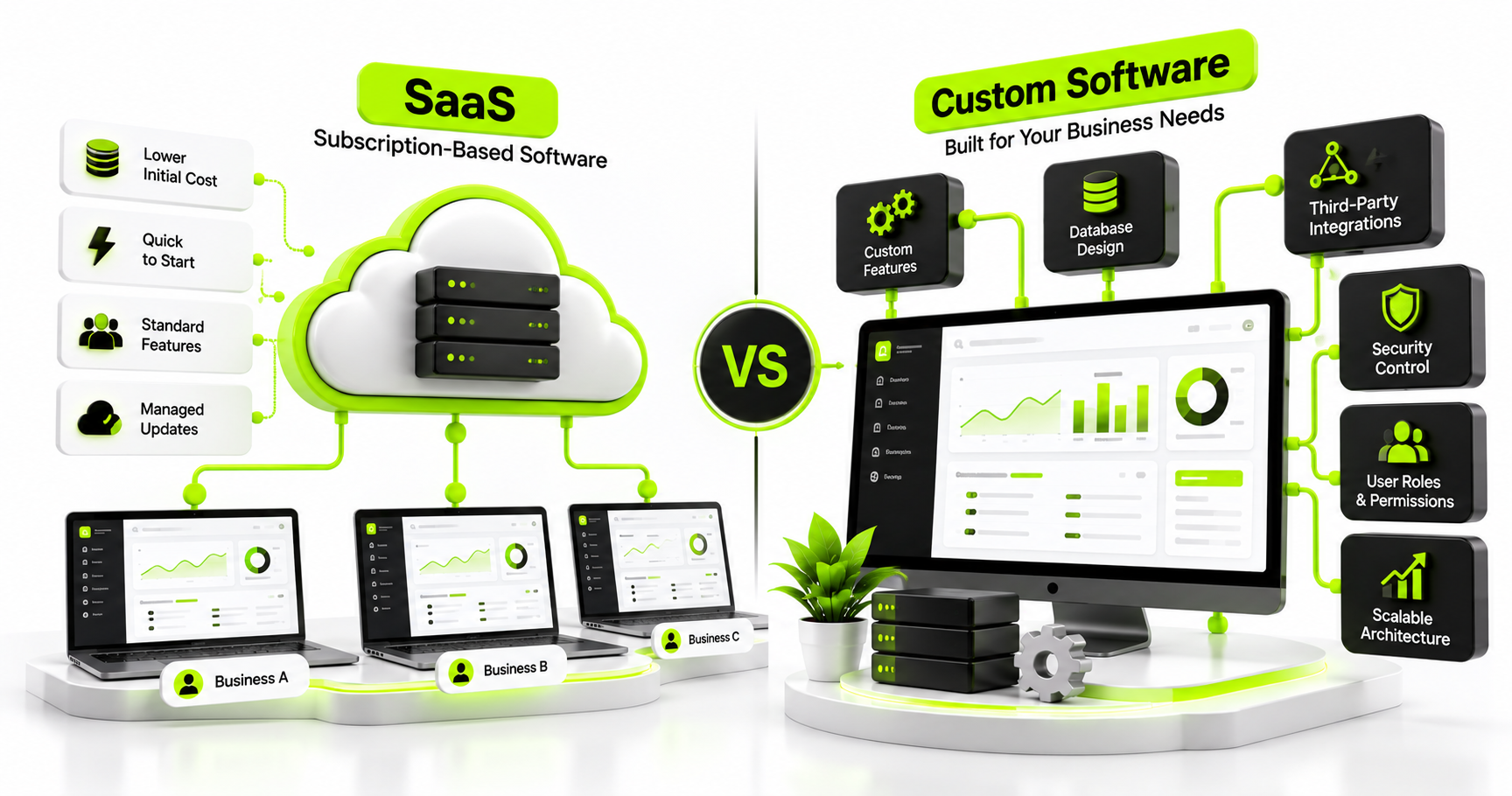
Choosing between SaaS and custom software development depends on your business requirements, budget, workflows, and long-term plans. SaaS products provide access to existing software through a subscription or usage-based model, while custom software is developed around the specific requirements of an organisation.
Both approaches can help businesses improve efficiency, manage information, and automate operations. However, they differ in implementation, flexibility, ownership, ongoing costs, and the level of control available to your team.
In this guide, we compare SaaS and custom software development to help you determine which approach is suitable for your business.
What is SaaS software?
Software as a Service (SaaS) is a software delivery model in which users access an application over the internet. The provider typically manages the underlying application and agreed infrastructure, while customers pay through subscriptions or usage-based charges.
Examples include CRM platforms, accounting applications, project management tools, email marketing systems, and customer support software.
SaaS can help businesses start using software without funding a complete custom development project. Depending on the product, users can register, configure their accounts, select a subscription plan, and begin working with relatively little implementation effort.
What is custom software development?
Custom software development involves designing and building an application around the specific requirements of a business or organisation.
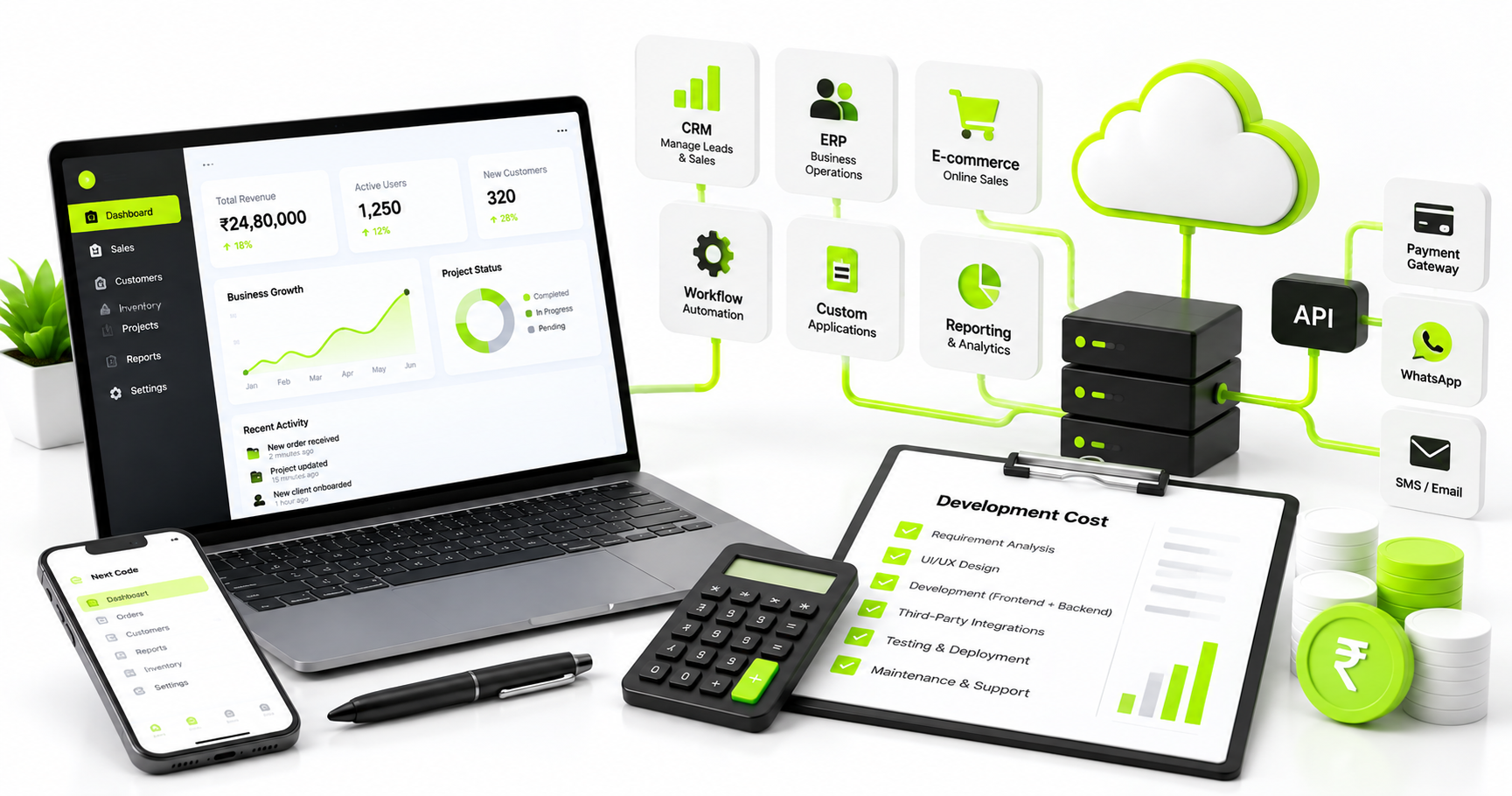
Examples include a tailored ERP system, a specialised order management platform, an internal operations dashboard, a multi-vendor marketplace, or a business application that connects several existing systems.
Custom software can provide greater control over workflows, integrations, and product direction. However, the organisation must plan for development, deployment, maintenance, security, and future enhancements.
SaaS vs custom software development: Key differences
| Factor | SaaS software | Custom software |
|---|---|---|
| Initial investment | Usually lower for standard requirements | Usually higher because development is required |
| Time to start | Often quick after setup and configuration | Depends on scope, design, and implementation |
| Features | Uses features offered by the provider | Can be designed around specific requirements |
| Ownership | Access is governed by the subscription and licence | Rights depend on the development contract and applicable licences |
| Integrations | Depends on available APIs and supported connectors | Can be designed for required integrations, subject to technical constraints |
| Maintenance | The provider manages agreed parts of the service | The owner must arrange ongoing maintenance and operations |
| Updates | Generally managed by the provider | Planned and delivered according to the support arrangement |
| Flexibility | Limited to available configuration and extension options | Can accommodate business-specific workflows |
| Long-term cost | Depends on subscriptions, users, usage, and plan changes | Depends on development, infrastructure, support, and enhancements |
Neither option is automatically better. The right choice depends on how closely an existing product fits your needs and how much control your business requires.
Which option costs less?
SaaS is often less expensive to start with because you can use an existing product instead of funding a full development project.
Custom software generally requires a larger initial investment because the team must analyse requirements, design workflows, develop features, test the application, and deploy the solution.
However, the initial price alone does not reveal the total cost of ownership.
When evaluating SaaS, consider:
- Monthly or annual subscription fees.
- Charges for additional users or usage.
- Premium features and integrations.
- Implementation, onboarding, and training.
- Data migration and export requirements.
When evaluating custom software, consider:
- Requirements analysis and UI/UX design.
- Frontend, backend, and integration development.
- Testing, deployment, and documentation.
- Hosting, backups, and monitoring.
- Maintenance, security updates, and future enhancements.
For a development budget reference, read our guide to SaaS development cost in India.
When should your business choose SaaS?
SaaS is a practical option when an established product already meets most of your business requirements.
Consider SaaS when:
- You need standard business functionality quickly.
- Your budget does not justify building a complete application.
- Your workflows fit the product's available configuration options.
- You want the provider to manage agreed infrastructure and software updates.
- You can work within the available integration and reporting options.
- You want to test a business process before investing in custom development.
For example, a small business may use an existing CRM to manage leads, track sales activities, and automate follow-ups. If the software supports the required workflow, building an entirely new CRM may not provide enough additional value to justify the investment.
When should your business choose custom software?
Custom software may be appropriate when standard products cannot support important business processes without expensive workarounds.
Consider custom development when:
- Your business has specialised workflows that existing tools cannot support.
- You need integrations that available products do not provide adequately.
- You require detailed control over roles, permissions, and business rules.
- Your product idea is itself a commercial software offering.
- You need a tailored customer, employee, or partner experience.
- You want to control the product roadmap within your contractual and technical rights.
For example, a delivery business with unusual scanning procedures, return workflows, driver earnings calculations, and operational reporting may need software designed around those specific processes.
Custom development is most valuable when the benefits of a tailored solution justify the initial investment and ongoing responsibilities.
Can SaaS software be customised?
Yes. Many SaaS products provide configuration options, custom fields, workflow builders, APIs, and third-party integrations.
These features may be sufficient to adapt an existing product to your organisation. However, customisation is not unlimited. Some changes may require higher subscription tiers, paid extensions, or third-party services.
Before choosing a SaaS product, confirm which requirements can be configured, which require external tools, and which cannot be supported.
If a critical workflow depends on unsupported functionality, compare the cost and complexity of workarounds against the cost of custom development.
Security, data access, and ownership
Security matters whether you choose SaaS or custom software. The important questions concern how information is protected, who can access it, how incidents are handled, and what happens when you leave the service or change providers.
For SaaS products, review:
- Access controls and authentication options.
- Data storage, export, retention, and deletion policies.
- Backup and recovery arrangements.
- Available security documentation and incident procedures.
- Contractual terms and responsibilities for protecting data.
For custom software, define:
- Authentication and role-based permissions.
- Secure data handling and API access.
- Hosting, backups, monitoring, and recovery.
- Source-code access and intellectual property terms.
- Documentation and handover responsibilities.
Custom software does not automatically provide stronger security, and SaaS is not automatically less secure. Evaluate the actual controls, implementation quality, provider responsibilities, and risks associated with your business.
Scalability and integrations
Both SaaS and custom software can support business growth, but the constraints differ.
A SaaS product may make it easier to add users or upgrade a subscription, although pricing, usage limits, and available functionality may change as your requirements grow.
Custom software can be designed to accommodate your expected workloads and integrations. However, its ability to scale depends on architecture, infrastructure, engineering quality, and operational planning.
Before making a decision, identify the systems your software must connect to, the volume of data it will process, and the performance your users expect.
What about a hybrid approach?
You do not always need to choose one approach for the entire business.
A hybrid approach combines existing SaaS products with custom software where tailored functionality is necessary.
For example, a business could use an existing accounting platform and email service while developing a custom order management system that connects inventory, deliveries, customer records, and internal workflows.
This approach can avoid rebuilding standard functionality while allowing you to control the processes that differentiate your business.
However, integrations introduce dependencies, data synchronisation requirements, and potential additional costs. Plan how information moves between systems and which system acts as the authoritative source for each type of record.
How to make the right decision
Before choosing SaaS or custom software development, answer these questions:
- Can an existing SaaS product meet your essential requirements?
- Which business workflows are unique or difficult to support?
- What is your initial budget and expected long-term expenditure?
- Which integrations are essential?
- What level of control do you need over data, functionality, and product direction?
- Who will manage maintenance, security, and support?
- How important are data portability and the ability to change providers?
- Would a hybrid solution meet your needs more efficiently?
Document your answers and compare the available options against your most important business requirements.
How Next Code Company can help
Choosing the right software approach starts with understanding your business problem, not selecting a technology before the requirements are clear.
Next Code Company works with businesses to plan and develop digital products, including custom web applications, business platforms, mobile applications, and software tailored to operational requirements.
Explore our portfolio and case studies to review relevant work. If existing software does not adequately support your workflows, discuss your custom software development requirements with NCC.
Frequently asked questions
Is SaaS better than custom software?
SaaS is often suitable when an existing product meets your requirements and you want to start quickly. Custom software may be better when specialised workflows, integrations, or product requirements justify a tailored solution.
Is custom software more expensive than SaaS?
Custom software generally requires a larger initial investment. SaaS usually involves recurring subscription fees. The long-term comparison depends on usage, user numbers, customisation needs, maintenance, and the expected life of the solution.
Can a small business afford custom software development?
Yes, depending on the scope and available budget. A small, focused application can be developed in stages, starting with essential workflows and expanding as business needs become clearer.
Can I switch from SaaS to custom software later?
Yes, but the transition may require data export, migration, workflow redesign, integration work, and user training. Review data portability and exit terms before committing to a SaaS provider.
Can custom software integrate with SaaS tools?
Yes, when the required APIs or supported integration methods are available. The implementation must account for permissions, data mapping, rate limits, errors, and ongoing compatibility.
Final thoughts
SaaS and custom software solve different business needs. SaaS can provide a fast, practical route to standard functionality, while custom development can support specialised workflows and tailored digital products.
Evaluate the total cost of ownership, operational responsibilities, integrations, flexibility, and long-term business value before choosing. In some cases, combining SaaS with custom software will provide the most practical solution.
Contact Next Code Company to discuss the right software approach for your business.
Published October 11, 2026. This article is a general software procurement guide, not a project quotation or a guarantee of cost savings or business outcomes.
Related articles
Have a story worth engineering?
We turn strategy into shipped software. Book a free consultation and we'll map the build, the timeline and the cost.