
How Much Does Custom Software Development Cost in India?
Discover how much custom software development costs in India. Compare project budgets, feature complexity, technology choices, integrations, maintenance, and the factors that influence your total investment.
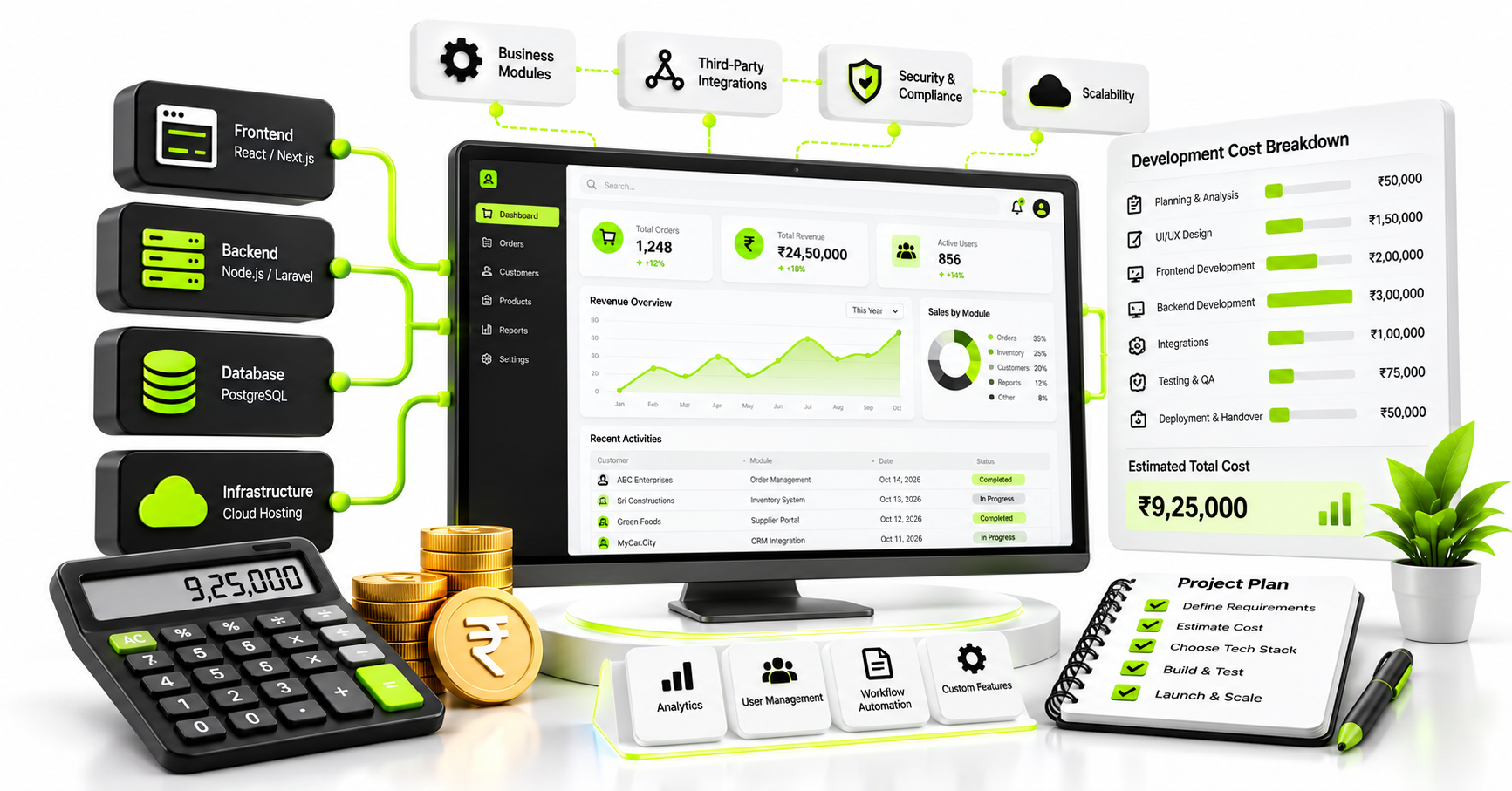
Custom software development costs in India can range from a few lakh rupees for a focused business application to several tens of lakhs or more for complex enterprise systems. The actual investment depends on the features you need, the number of user roles, integrations, security requirements, technology choices, and the amount of ongoing support required.
Whether you want to automate internal operations, build a customer portal, launch a marketplace, or replace spreadsheets with a central business system, understanding these cost factors helps you plan a realistic budget before development begins.
This guide explains indicative custom software development budgets in India, the components that influence pricing, ongoing costs, and practical ways to manage your investment.
How much does Custom Software Development Cost in India: A Business Owner’s Guide" class="underline decoration-[#A9E600] decoration-2 underline-offset-4 hover:text-[#111]">custom software development cost in India?
There is no single price for every software project. A simple internal tool with a few workflows requires a different level of effort from a multi-user business platform with complex permissions, integrations, reporting, and automation.
The following figures are illustrative planning estimates for custom software projects in India, not verified market averages or fixed quotations.
| Project type | Indicative budget | Typical scope |
|---|---|---|
| Basic business application | ₹2 lakh–₹5 lakh | Simple workflows, user accounts, forms, and basic reporting |
| Small business management system | ₹4 lakh–₹10 lakh | Multiple modules, roles, dashboards, and operational workflows |
| Advanced web application | ₹8 lakh–₹20 lakh | Complex business logic, APIs, integrations, and reporting |
| Marketplace or multi-user platform | ₹10 lakh–₹30 lakh+ | Multiple user types, transactions, administration, and connected workflows |
| Enterprise software system | ₹25 lakh–₹50 lakh+ | Complex integrations, advanced permissions, migration, and operational requirements |
These ranges can overlap significantly. A relatively small application with complex integrations or stringent security requirements may cost more than a larger product with straightforward functionality.
Use the figures to begin budgeting, then request a project-specific estimate based on a documented feature list and delivery scope.
What factors affect custom software development costs?
1. Feature complexity
The number of features is only part of the equation. Their complexity also matters.
A basic customer database is generally simpler than a system that handles approval workflows, automated calculations, exception handling, and multiple reporting requirements.
List the features required for the first release and separate them from enhancements that can be introduced later. This helps the development team estimate the work more accurately.
2. User roles and permissions
Software used by administrators, managers, employees, customers, and external partners may require different dashboards and access rules.
Each additional role can introduce requirements for permissions, approval processes, testing, and reporting. Sensitive actions should be authorised by the backend rather than controlled only through the interface.
3. UI/UX design
A well-designed application should make important tasks easy to understand and complete. Design effort depends on the number of screens, user journeys, responsive layouts, and the complexity of the workflows.
Ask whether your quotation includes requirements analysis, wireframes, prototypes, visual design, usability reviews, and mobile-responsive layouts.
4. Backend and database architecture
The backend handles business rules, data processing, authentication, APIs, and communication between different parts of the application.
A simple application may need a straightforward architecture, while a platform with multiple modules, large data volumes, or complex permissions may require more detailed planning and testing.
The objective is to choose an architecture that meets your requirements without introducing unnecessary complexity.
5. Third-party integrations
Many business applications connect to external services, including:
- Payment gateways and billing platforms.
- Accounting and invoicing systems.
- CRM and marketing automation tools.
- Maps, logistics, and delivery services.
- Email, SMS, and WhatsApp messaging providers.
- AI APIs, analytics platforms, and reporting tools.
Integration costs depend on API availability, documentation, authentication, data mapping, synchronisation, error handling, and testing. Third-party subscription and usage fees may also apply separately.
6. Data migration and existing systems
If you are replacing spreadsheets or legacy software, the project may need to migrate customer records, products, transactions, documents, and historical data.
Migration effort depends on data quality, volume, formatting, duplicate records, validation requirements, and whether the old system provides a reliable export method.
Clarify who will prepare the data, clean existing records, validate the migration, and approve the final results.
Custom software development cost breakdown
Ask your development partner to explain how the total budget is distributed across the project.
| Component | What it includes |
|---|---|
| Discovery and planning | Requirements, workflows, scope, and technical decisions |
| UI/UX design | Wireframes, prototypes, visual design, and responsive layouts |
| Frontend development | Interfaces, dashboards, forms, and user interactions |
| Backend development | Business logic, APIs, authentication, and database operations |
| Integrations | External services, data synchronisation, and automation |
| Quality assurance | Functional testing, compatibility checks, and defect correction |
| Deployment and handover | Production setup, documentation, access, and release preparation |
Not every project will charge for these activities separately. A breakdown helps you understand what the quotation includes and identify missing responsibilities before signing.
Web application vs mobile app development cost
The type of software you build affects the scope and budget.
A browser-based business application may be sufficient for internal workflows, administration, reporting, and customer portals. A mobile application may be necessary when customers need frequent mobile access, push notifications, or specific device capabilities.
Developing for both web and mobile can increase the initial scope, although a shared backend may reduce duplicated business logic.
Before deciding, consider where users will work, which device features are essential, and whether one interface can support the initial release.
Read our related guide to Web App vs Mobile App to compare the options.
How much does custom ERP or business management software cost?
Business management systems often combine several workflows, such as inventory, purchasing, sales, employee access, reporting, and financial processes.
The cost depends on the number of modules, the complexity of business rules, the integrations required, and whether existing data must be migrated.
For example, a basic inventory application may track products and stock movements. A more advanced system may need warehouse-level stock, batch tracking, purchase approvals, multiple locations, and integrations with accounting or e-commerce platforms.
Define which modules are essential at launch. Building the system in phases can make implementation easier to manage while allowing your team to validate each stage.
Ongoing software maintenance costs
Custom software requires attention after launch. Operating systems, dependencies, external APIs, security requirements, and business workflows change over time.
Plan for expenses such as:
- Cloud hosting, databases, and storage.
- Monitoring, backups, and recovery.
- Security updates and dependency maintenance.
- Bug fixes and compatibility updates.
- Technical support and incident response.
- New features and workflow changes.
There is no universal maintenance percentage that suits every application. A small internal tool and a business-critical platform with demanding availability requirements will have different support needs.
Ask for a separate maintenance proposal that specifies covered activities, response expectations, service hours, exclusions, and charges for additional development.
How to reduce custom software development costs
You can manage your budget without compromising essential security or reliability by making deliberate decisions about scope and delivery.
- Define the business problem: Focus on the outcome the software must achieve.
- Prioritise essential features: Build the core workflow before adding optional modules.
- Reuse proven services: Use appropriate authentication, payment, and infrastructure services where they meet your requirements.
- Keep the architecture proportionate: Avoid unnecessary complexity before there is a clear need.
- Agree on acceptance criteria: Define how completed features will be evaluated.
- Plan integrations early: Confirm API access, fees, dependencies, and technical constraints.
- Test important workflows early: Validate permissions, calculations, and data handling before release.
Reducing unnecessary scope is generally more effective than cutting testing or security work that the application genuinely needs.
How long does custom software development take?
A focused business application may take a few months, while a complex platform can require several months or longer. Timelines depend on scope, integrations, data migration, team capacity, review cycles, and the availability of business stakeholders.
Ask for a milestone-based plan covering requirements, design, development, testing, deployment, and handover. Clarify how changes to the agreed scope will affect the schedule and budget.
How to choose a custom software development company
Choose a development partner that understands your business requirements and can explain how the proposed software will support them.
Before signing an agreement, check:
- Relevant project experience and demonstrable work.
- The proposed team and delivery responsibilities.
- A written feature list and milestone schedule.
- Testing, security, and deployment arrangements.
- Source-code ownership and production account access.
- Documentation, handover, and ongoing support terms.
Compare proposals on equivalent scope rather than choosing solely on the lowest quoted price.
Explore Next Code Company's portfolio and case studies to review relevant work. If your business needs a tailored application, discuss your custom software development requirements with NCC.
Frequently asked questions
What is the minimum cost of custom software development in India?
The minimum investment depends on the required features, design, integrations, and security requirements. A focused application may require a smaller budget than a platform with multiple modules and complex workflows. Request a scoped quotation to establish a realistic figure.
Is custom software cheaper than buying existing software?
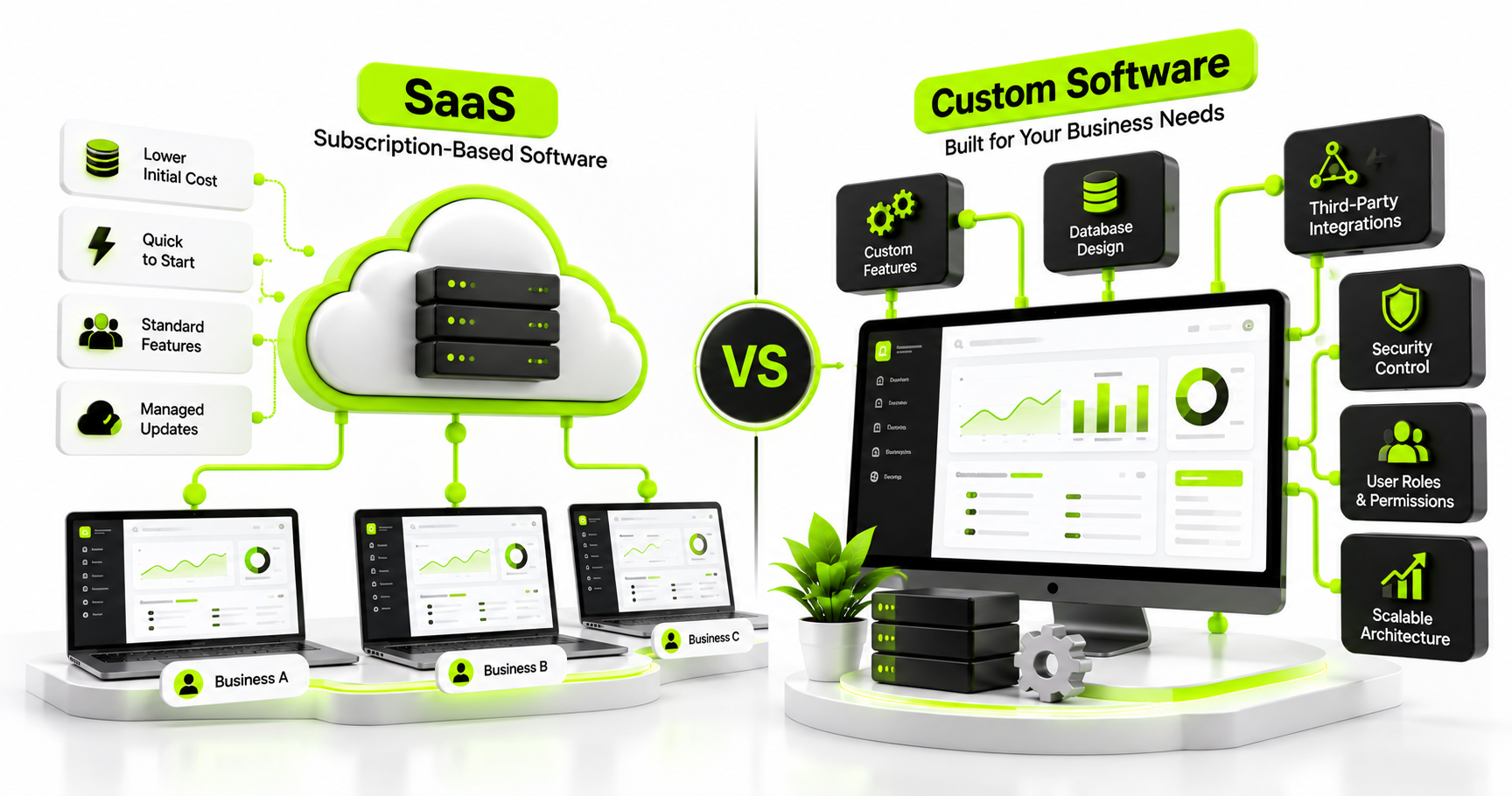
Existing software often has a lower initial cost. Custom development may be justified when standard tools cannot support critical workflows or when the tailored product provides sufficient business value. Compare the full cost of implementation, subscriptions, maintenance, and future changes.
Does the development cost include hosting?
Not necessarily. Some proposals include initial deployment and setup, while ongoing hosting, storage, and third-party services are billed separately. Confirm these details before approving the budget.
Can custom software be developed in phases?
Yes. A phased approach can deliver essential functionality first and add further modules as requirements become clearer. The architecture should be planned to support the expected next stages without unnecessary rework.
Who owns the source code after development?
Ownership depends on the contract, applicable law, and third-party licences. Explicitly agree on intellectual property rights, repository access, documentation, reusable components, and transfer arrangements.
Final thoughts
Custom software development costs in India depend on the business problem, feature complexity, integrations, security requirements, and long-term operating needs.
Start with clear requirements, prioritise the first release, compare proposals on equivalent scope, and budget for maintenance as well as development. This gives you a more realistic view of the investment required to build and operate useful business software.
Next Code Company helps businesses plan and develop software tailored to their operational requirements. Contact NCC to discuss your software idea, scope, and budget.
Published October 14, 2026. Cost ranges are illustrative planning estimates, not verified market averages or a quotation. Actual project costs and timelines depend on the agreed scope.
Related articles

Have a story worth engineering?
We turn strategy into shipped software. Book a free consultation and we'll map the build, the timeline and the cost.