
How Much Does E-commerce App Development Cost in India?
Planning to build an e-commerce app? Explore development costs in India, including shopping features, payment gateways, inventory management, delivery tracking, admin dashboards, and ongoing maintenance.
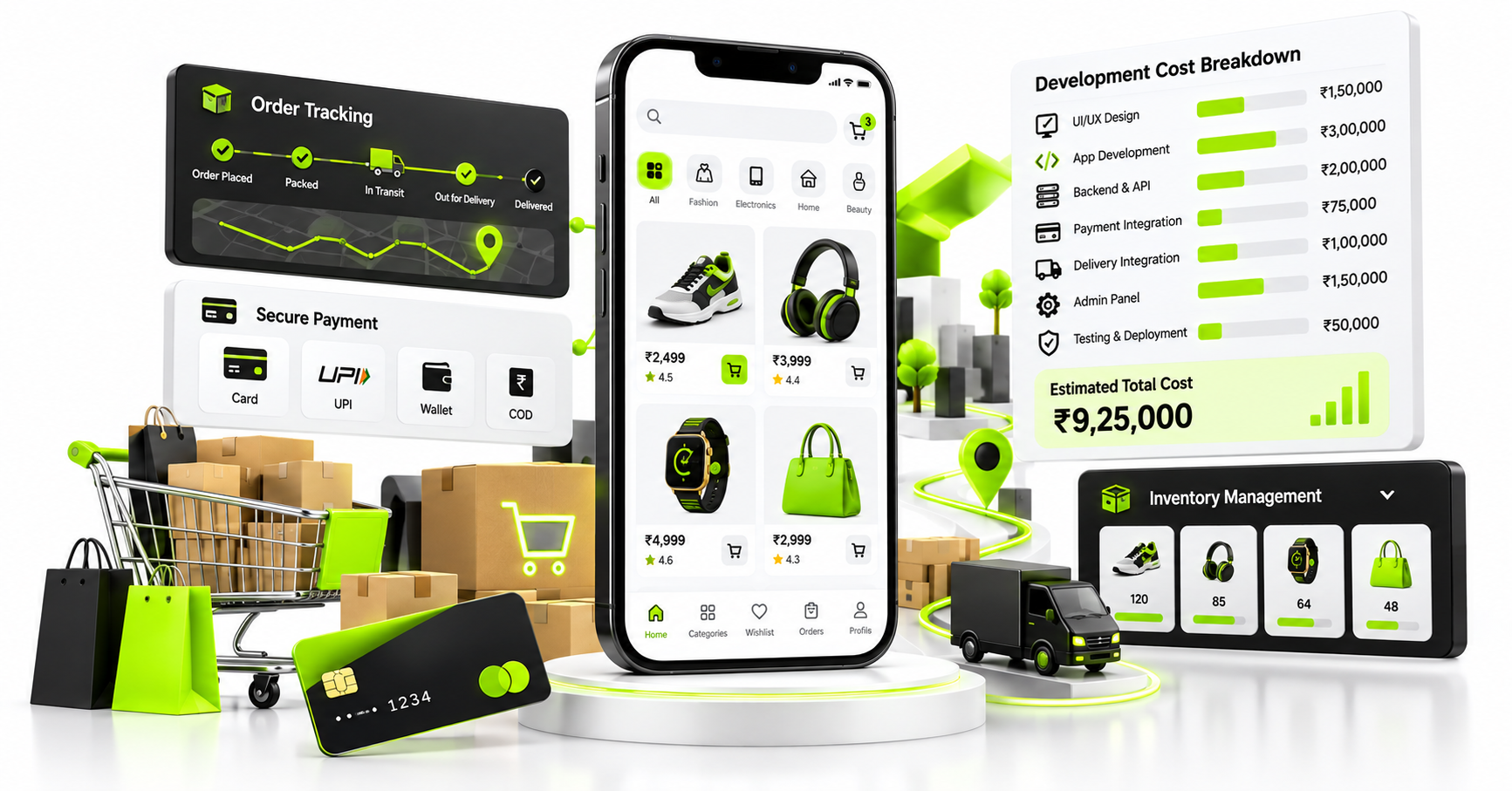
The cost of developing an e-commerce app in India depends on how customers shop, how orders are processed, and how much of your business operation needs to be automated. A basic shopping application with product listings and online payments requires a different investment from a platform with inventory synchronisation, multiple delivery options, loyalty programmes, and advanced analytics.
Whether you are a retailer moving online, a D2C brand expanding beyond a website, or a startup building a shopping marketplace, understanding the development costs can help you plan your first release and avoid unnecessary expenditure.
This guide covers indicative e-commerce app development budgets in India, essential features, integrations, recurring expenses, and ways to control the initial investment.
How much does e-commerce app development cost in India?
There is no fixed price for every e-commerce application. The budget depends on the number of platforms, the complexity of the shopping experience, backend requirements, integrations, and operational workflows.
The following figures are illustrative planning estimates for custom development in India, not verified market averages or fixed quotations.
| Application type | Indicative budget | Typical scope |
|---|---|---|
| Basic shopping app | ₹3 lakh–₹7 lakh | Product catalogue, customer accounts, cart, and basic checkout |
| Standard e-commerce app | ₹6 lakh–₹12 lakh | Payments, order history, promotions, notifications, and admin dashboard |
| Advanced e-commerce platform | ₹10 lakh–₹20 lakh+ | Inventory workflows, delivery tracking, advanced promotions, and integrations |
| Multi-vendor marketplace | ₹15 lakh–₹35 lakh+ | Seller accounts, product approvals, commissions, and multiple order workflows |
| Enterprise commerce platform | ₹30 lakh–₹50 lakh+ | Complex integrations, multiple warehouses, advanced analytics, and high operational demands |
These ranges overlap because project requirements vary considerably. A small catalogue with complex fulfilment rules may cost more than a larger catalogue with straightforward ordering.
Request a quotation based on the same feature list and delivery scope when comparing development companies.
What features affect e-commerce app development cost?
1. Product catalogue and search
The product catalogue is the foundation of most shopping applications. Basic catalogues may contain product images, descriptions, prices, and categories.
More advanced applications may require product variants, stock availability, attribute filters, sorting, search suggestions, wishlists, and personalised recommendations.
The amount and complexity of product information influence how the catalogue, database, search, and administration tools need to be designed.
2. Shopping cart and checkout
The cart and checkout flow directly affect the customer's ability to complete a purchase.
Typical requirements include cart management, delivery addresses, shipping calculations, coupon codes, taxes, order summaries, payment status, and order confirmation.
Additional rules, such as minimum order values, product restrictions, multiple shipments, and partial fulfilment, can increase development and testing effort.
3. Payment gateway integration
An e-commerce app may support online payments, cash on delivery, refunds, and transaction status updates, depending on the business model and payment provider.
Payment integration involves more than adding a checkout button. The application must handle payment confirmation, failed transactions, duplicate callbacks, refunds, and order reconciliation correctly.
Payment gateway charges, transaction fees, and any provider subscription costs are separate from software development charges unless expressly included in the quotation.
4. Inventory and order management
Inventory requirements can significantly affect the project's complexity.
A small retailer may need basic stock updates, while a larger business may require multiple warehouses, stock reservations, returns, damaged-stock handling, purchase orders, and synchronisation with other sales channels.
Define how stock changes when orders are placed, cancelled, returned, or partially fulfilled. These rules help prevent overselling and inconsistent inventory records.
5. Delivery and order tracking
Delivery features depend on how orders reach customers. A basic application may display order statuses, while a more advanced system may integrate courier APIs, delivery assignment, shipment tracking, and proof of delivery.
Third-party delivery integrations can introduce additional provider charges and technical dependencies. Confirm API availability, service coverage, tracking frequency, and failure-handling requirements before estimating the scope.
6. Admin dashboard
The administration dashboard enables the business to manage products, customers, orders, inventory, promotions, and operational settings.
A basic dashboard may be sufficient for a small store. A larger business may need staff roles, approval workflows, reports, refunds, seller management, and audit logs.
Clarify whether the quotation includes the admin panel, as customer-facing app development alone may not cover the tools needed to operate the business.
Android, iOS, or both: How does the platform affect cost?
Your budget depends partly on which platforms you need to support.
- Android app: Suitable when your target customers primarily use Android devices.
- iOS app: Appropriate when your customer base or product strategy requires an iPhone application.
- Cross-platform app: Frameworks such as Flutter can share much of the code between Android and iOS.
- Web-based shopping experience: A responsive e-commerce website can provide an initial purchasing channel without requiring customers to install an app.
Cross-platform development can reduce duplicated implementation effort, but both platforms still require appropriate testing and may need platform-specific integrations.
If your budget is limited, consider whether a responsive website or a focused mobile app provides the best first step for validating customer demand.
How much does a multi-vendor shopping app cost?
A multi-vendor marketplace is more complex than a single-store shopping app because the platform must support multiple sellers and coordinate their activities.
Additional features may include:
- Seller registration and onboarding.
- Product submission and approval.
- Seller-specific inventory and order management.
- Commission calculations and sales reports.
- Returns, cancellations, and dispute workflows.
- Seller dashboards and administrative controls.
Depending on the commercial model, payment distribution and seller settlements may introduce additional integration and compliance requirements. Confirm the supported payment-provider capabilities and responsibilities before including these features in a quotation.
For an initial marketplace, launching with essential seller and order workflows can help manage the budget before introducing advanced settlement and automation features.
Website vs mobile app for e-commerce
An e-commerce website and a mobile application serve related but different purposes.
A website can make products accessible through search engines and shareable links. A mobile application can support app-specific experiences such as push notifications, convenient repeat purchases, and certain device capabilities.
Building both may be appropriate when your business needs to reach new customers through the web while providing an enhanced experience for returning customers.
Consider your customer acquisition strategy, repeat-purchase frequency, budget, and existing online sales before deciding which channels to develop first.
Additional costs beyond development
Your development quotation is only one part of the total investment required to operate an e-commerce business.
- Hosting and infrastructure: Depend on traffic, storage, performance, and availability requirements.
- Payment processing: Depends on transaction volume and the selected provider.
- Courier services: May involve shipping, tracking, and integration charges.
- SMS, email, and notifications: Depend on provider pricing and message volume.
- Product content: Includes photography, descriptions, catalogue preparation, and data entry.
- Maintenance and support: Cover agreed bug fixes, updates, monitoring, and operational assistance.
- Marketing and customer acquisition: Include advertising, promotions, and retention activities.
Estimate these recurring expenses separately and model them against your expected order volume and revenue.
How to reduce e-commerce app development costs
You can manage the initial investment by focusing on essential functionality and avoiding unnecessary complexity.
- Start with a defined product category: Launch with the catalogue and workflows your initial customers need.
- Prioritise checkout reliability: Make browsing, ordering, and payment work correctly before adding advanced features.
- Use proven services: Consider established payment, notification, and delivery integrations where they meet your requirements.
- Plan the admin dashboard early: Make sure the business can manage orders and products after launch.
- Define inventory rules: Clarify stock, cancellation, returns, and refund behaviour before development.
- Build in phases: Add loyalty programmes, advanced recommendations, and sophisticated analytics when they provide measurable value.
- Agree acceptance criteria: Document what each feature must do before approving the milestone.
Do not reduce costs by skipping essential payment testing, access controls, backup planning, or data protection.
How long does e-commerce app development take?
A basic shopping app may take a few months, while an advanced e-commerce platform or multi-vendor marketplace can take several months or longer.
The schedule depends on design, catalogue complexity, integrations, inventory rules, testing, and the speed of business decisions.
Ask for a milestone-based delivery plan covering requirements, design, implementation, testing, deployment, and handover. Confirm who will provide product data, payment accounts, courier credentials, and other dependencies.
How to choose an e-commerce app development company
Choose a development partner that understands both the customer shopping experience and the operational workflows required to run your store.
Before signing, ask:
- Has the team built applications with comparable commerce workflows?
- Does the quotation include the customer app, backend, and admin dashboard?
- How are payments, refunds, stock updates, and order statuses handled?
- Which third-party integrations and provider fees are included?
- Who owns the source code and controls the production accounts?
- What testing, handover, maintenance, and support are included?
Compare proposals on equivalent scope rather than selecting a company solely on the lowest quoted price.
Explore Next Code Company's portfolio and case studies to assess relevant experience. If you are planning a shopping app or marketplace, discuss your e-commerce app development requirements with NCC.
Frequently asked questions
What is the minimum cost to develop an e-commerce app in India?
The budget depends on the required platforms, catalogue, checkout, integrations, and administration features. A focused shopping app generally requires less work than a multi-vendor marketplace with advanced inventory and seller workflows. Request a scoped quotation for a reliable estimate.
Does e-commerce app development include a website?
Not necessarily. A mobile app and a responsive e-commerce website may be separate deliverables. Confirm whether the quotation includes the website, admin dashboard, backend, and mobile applications.
Can I build an e-commerce app using Flutter?
Yes. Flutter can support Android and iOS applications through a shared codebase for much of the interface and business logic. The final architecture and integrations should be selected according to your requirements.
How much does payment gateway integration cost?
Development charges depend on the integration scope and transaction workflows. Payment processing fees are separate and depend on the provider's terms. Ask for both costs to be stated clearly.
Should I build a shopping app or marketplace?
A shopping app is generally suitable when one business sells its own products. A marketplace is appropriate when multiple sellers need to manage products and orders through the same platform. Choose according to your business model.
Final thoughts
E-commerce app development costs depend on the shopping experience, payment workflows, inventory management, delivery integrations, and the operational tools your business needs.
Start with a clear business model, prioritise the essential buying journey, and obtain a detailed estimate covering the customer application, backend, administration, integrations, and ongoing expenses.
Next Code Company helps businesses plan and develop digital platforms around their requirements. Contact NCC to discuss your e-commerce app idea and development budget.
Published October 14, 2026. Cost ranges are illustrative planning estimates, not verified market averages or a quotation. Actual project costs and timelines depend on the agreed scope.
Related articles
Have a story worth engineering?
We turn strategy into shipped software. Book a free consultation and we'll map the build, the timeline and the cost.