
How Much Does It Actually Cost to Build a Mobile App in India? A Complete Cost Breakdown
Understand the actual cost of developing a business-ready mobile application in India. Explore development team requirements, UI/UX design, frontend and backend development, testing, hosting, and third-party service expenses to plan your app budget realistically.
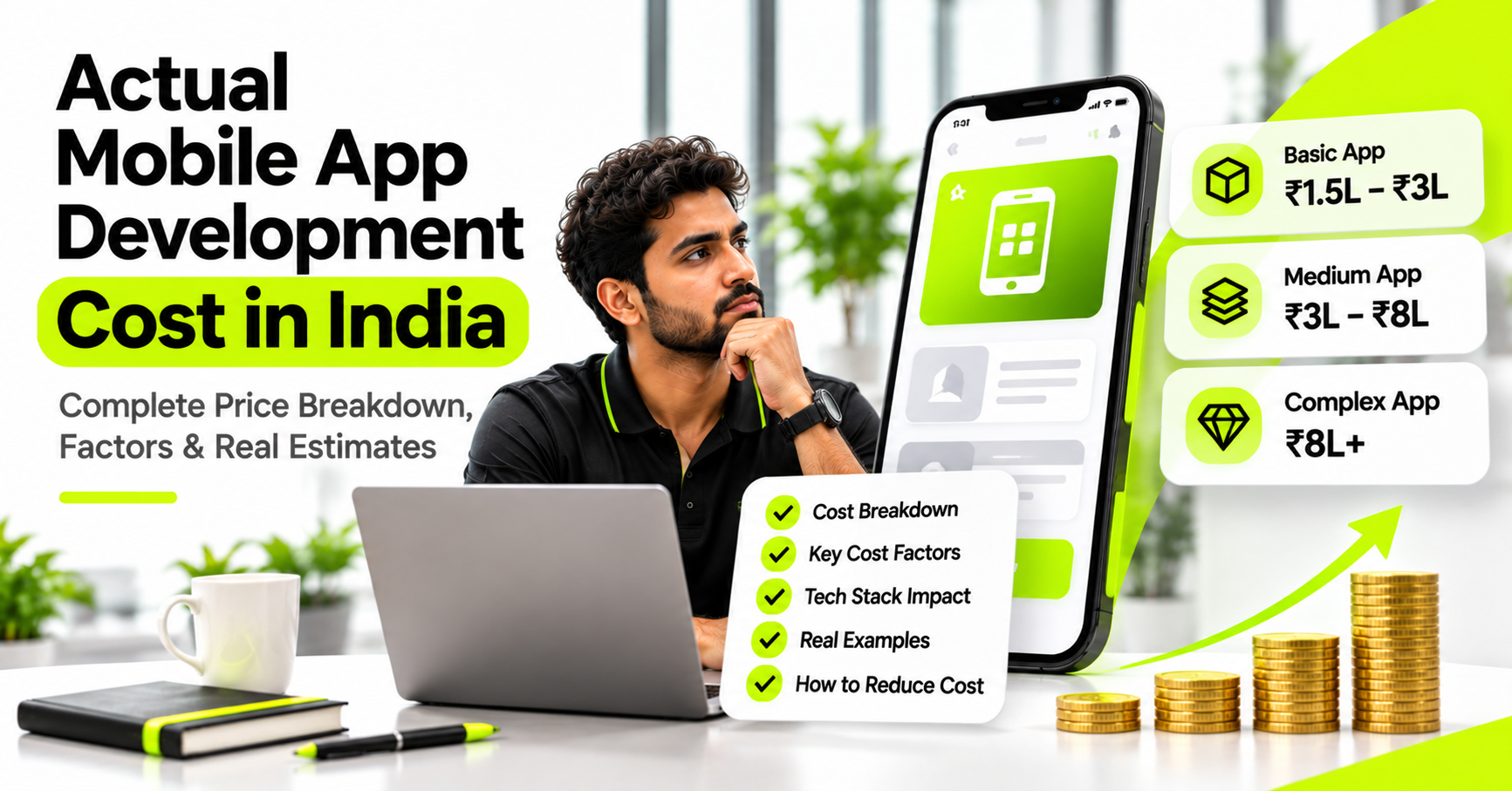
How Much Does It Actually Cost to Build a Mobile App in India? A Complete Cost Breakdown
One of the first questions business owners ask before developing an application is: How much will it cost?
You may receive quotations of ₹40,000, ₹75,000, ₹2 lakh, ₹5 lakh, or even ₹15 lakh for applications that appear similar at first glance.
The reason is simple: an app's cost depends on what needs to be designed, developed, integrated, tested, deployed, and maintained.
Let's break down the economics using a practical example.
1. What Determines Mobile App Development Cost?
- Number of applications and user roles
- Number and complexity of screens
- UI/UX design requirements
- Frontend development
- Backend and database architecture
- Third-party integrations
- Security and access controls
- Testing and deployment
- Post-launch support
2. The Team Behind an Application
A typical business application may require several responsibilities:
| Role | Primary responsibility |
|---|---|
| UI/UX Designer | User journeys, wireframes and Figma designs |
| Frontend Developer | Web interface and user interactions |
| Backend Developer | APIs, database and business logic |
| Mobile Developer | Android and iOS application development |
| QA Engineer | Functional, device and regression testing |
| Project Manager | Requirements, planning and delivery coordination |
One experienced developer may cover multiple responsibilities on a small project. More complex projects need more specialised allocation.
3. Example: A Home Services Application
Imagine you want to build a home-services platform with a customer app, a service partner app, and an admin dashboard.
The scope includes registration, service listings, bookings, scheduling, staff allocation, online payments, notifications, and reports.
Consider this illustrative allocation:
| Role | Allocation | Estimated cost |
|---|---|---|
| UI/UX Designer | 1 month | ₹40,000 |
| Frontend Developer | 2 months | ₹1,10,000 |
| Backend Developer | 2 months | ₹1,20,000 |
| Mobile Developer | 2 months | ₹1,20,000 |
| QA Engineer | 1 month | ₹35,000 |
| Project Manager | 1 month | ₹50,000 |
| Total | ₹4,75,000 |
These are illustrative salary allocations, not a standard industry quotation. The actual team, timeline, and cost will change according to the scope, technology, experience, and delivery approach.
4. Development Is Not the Only Expense
After development, you may need to budget for:
- Google Play Console registration – US$25 one-time
- Apple Developer Program – US$99 annually
- Server hosting and infrastructure
- Domain and email services
- SMS and OTP delivery
- Payment gateway transaction fees
- Maps and location services
- Cloud storage and backups
- Monitoring and maintenance
Read the individual guides for Google Play Console registration, Apple Developer membership, Hostinger VPS hosting, MSG91 DLT registration, and Razorpay payment gateway charges.
5. Prototype, MVP and Production Application: Understand the Difference
Prototype
A prototype demonstrates how an application may look and behave. It can be useful for presentations, feedback, and early validation. It may not contain a production backend or real payment processing.
Minimum Viable Product
An MVP is a limited but usable product that supports a defined set of essential user workflows. It should be scoped carefully so that the first release can serve its intended users.
Production Application
A production application is prepared for real operations. It needs suitable security, error handling, testing, deployment, monitoring, and support based on its business requirements.
6. Why Two Development Companies Can Quote Different Prices
One company may use a ready-made template and existing services. Another may design a custom experience, build a dedicated backend, and implement complex workflows.
Both approaches can be valid for different requirements. What matters is whether the proposed solution actually meets the business need.
Before comparing quotations, check the deliverables, team allocation, source-code ownership, third-party expenses, testing, and support.
Read our practical guide: How to Evaluate a Mobile App Development Quotation.
7. How to Control Your App Development Budget
- Start with clear business requirements.
- Separate essential features from future enhancements.
- Build a prototype if the idea needs validation.
- Launch a focused MVP before expanding.
- Use existing services where they genuinely meet your needs.
- Keep third-party accounts under your business ownership.
- Plan for maintenance and infrastructure from the beginning.
Final Thoughts
There is no universal price for mobile app development. The right cost is determined by the work required to deliver the agreed product.
Instead of asking only how much an app costs, ask what the quotation includes, who will build it, how long it will take, and what happens after launch.
Planning Your Mobile App?
Next Code Company helps businesses plan and develop mobile applications, custom software, SaaS products, and digital platforms.
Let's understand your requirements before deciding your development budget.
Related articles
Have a story worth engineering?
We turn strategy into shipped software. Book a free consultation and we'll map the build, the timeline and the cost.