Custom CRM Development: When to Build Your Own CRM and What It Needs
When a custom CRM makes sense, the modules and Indian integrations it needs (Meta Lead Ads, WhatsApp, calling, UPI), and how to choose a CRM development company.
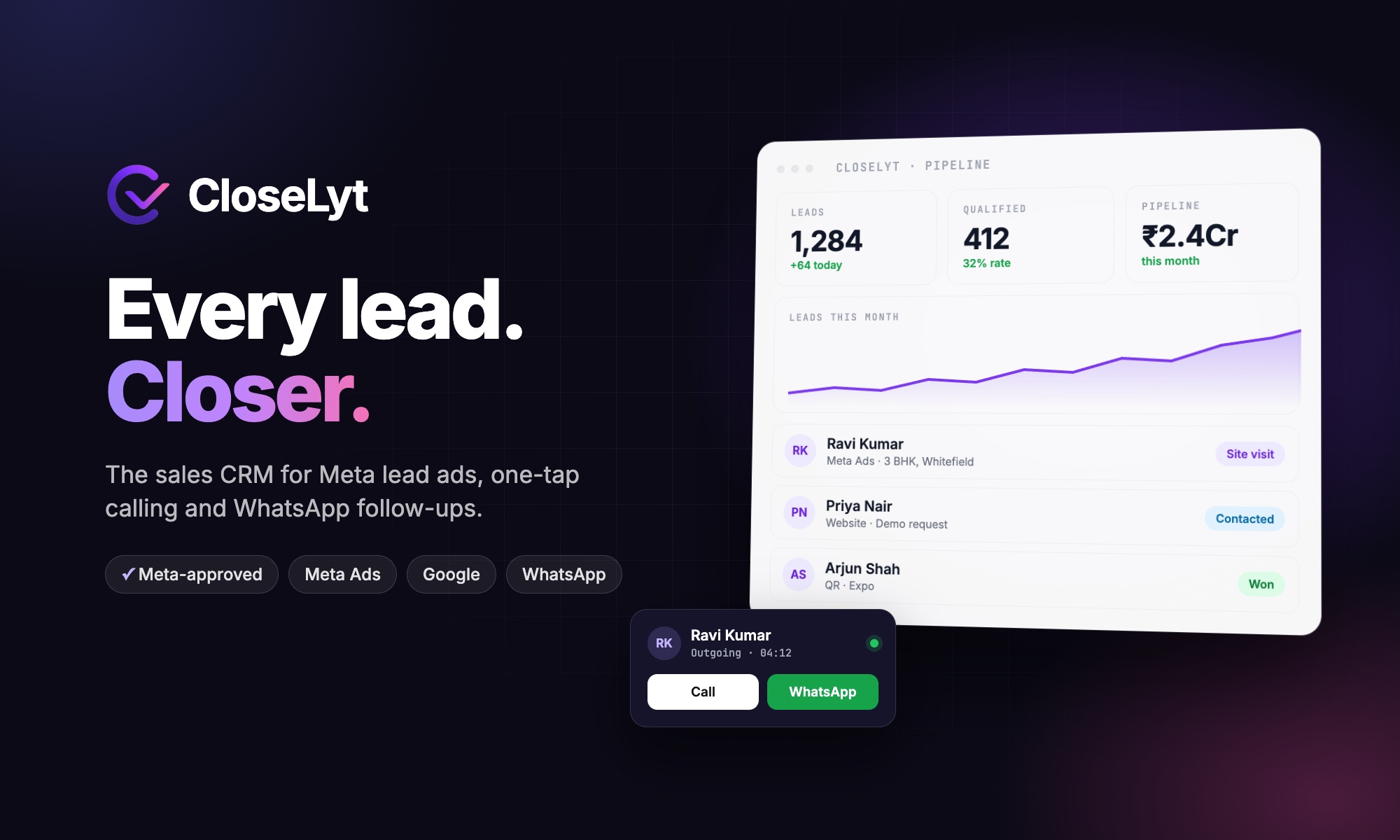
Custom CRM development means building a customer relationship management system around the way your business actually sells, instead of bending your process to fit a ready-made product. For many Indian businesses, especially those running on Meta ads, phone calls and WhatsApp, it is the difference between a CRM the team avoids and one they use every day.
This guide covers when a custom CRM makes sense, the modules it needs, the integrations that matter in India, and how to choose a CRM development company. It draws on our experience building CloseLyt, the AI sales CRM we designed and run ourselves.
Ready-made CRM or custom CRM?
| Ready-made CRM | Custom CRM | |
|---|---|---|
| Start time | Days | Weeks to months |
| Fit to your process | You adapt to it | It adapts to you |
| Cost model | Per-user subscription, forever | Build cost plus hosting and support |
| Integrations | Those the vendor offers | Any system you use |
| Data and ownership | Vendor's platform | Your system and your data |
Choose ready-made when your sales process is standard and your team is small. Products like CloseLyt already cover Meta Lead Ads, calling and WhatsApp for Indian teams.
Choose custom when:
- your sales process has steps generic CRMs cannot model (site visits, inspections, approvals, quotations with your own pricing);
- the CRM must connect deeply to your own systems: ERP, billing, inventory, a customer app;
- per-user licence costs keep growing with your team;
- you want to sell the CRM itself as a product to your industry.
Core modules of a CRM
- Lead and contact management: one record per lead with source, campaign, owner, stage, value and history.
- Lead capture: ads, website forms, QR codes, WhatsApp, imports and an API.
- De-duplication and validation: check phone numbers and match against existing leads before creating new ones.
- Assignment and routing: rules by campaign, city, product or round-robin.
- Pipeline and stages: configurable stages per team or industry.
- Activities: calls with outcomes, WhatsApp messages, meetings and notes on one timeline.
- Follow-ups: scheduled tasks with reminders and escalation when they are missed.
- Reports: source and campaign performance, stage conversion, team activity and revenue.
- Roles and permissions: who sees which leads, enforced on the server.
- Mobile app: for field and sales teams who live on their phones.
Integrations that matter for Indian sales teams
- Meta Lead Ads: receive leads the moment a form is submitted, not hours later from a CSV.
- Meta Conversions API: send closed deals back to Meta so campaigns optimise for real customers.
- WhatsApp Business: approved templates, automation and conversation history.
- Calling: one-tap calls from the lead record, with outcomes and durations logged.
- Google Forms, Sheets and website forms: no lead left in a spreadsheet.
- Payments: UPI and payment gateways for quotations and bookings; UPI AutoPay if you sell subscriptions.
Building a CRM as a SaaS product
If you plan to sell your CRM to other businesses, the system also needs:
- Multi-tenant workspaces with strict data isolation between companies.
- Self-serve sign-up, free trials and subscription billing.
- Industry templates so each customer starts with stages and fields that fit them.
- A super admin panel for plans, users, support and app releases.
We built all of these for CloseLyt. Read the CloseLyt case study for the full story, and our SaaS development services.
How to choose a CRM development company
- Ask for a CRM or SaaS product they built and run, not only screenshots.
- Check experience with Meta, WhatsApp and payment integrations in production.
- Confirm you own the code and data, and how hosting and support work.
- Prefer a phased plan: a working first release, then automation and analytics.
- Make sure they build a mobile app if your team works in the field.
Frequently asked questions
How long does custom CRM development take?
A focused first release with lead capture, pipeline, calls, follow-ups and reports usually takes a few months. Integrations, automation and a mobile app add time. We confirm the timeline in a written scope.
How much does a custom CRM cost in India?
It depends on modules, integrations and whether it is for internal use or a SaaS product. Our custom software cost guide explains typical budgets, and we send a fixed quote after a free consultation.
Can a CRM connect to our existing software?
Yes. A custom CRM can connect to ERPs, billing, inventory and customer apps through APIs and webhooks.
Looking for a CRM development company in Hyderabad? Book a free consultation with Next Code Company.
Related articles
Have a story worth engineering?
We turn strategy into shipped software. Book a free consultation and we'll map the build, the timeline and the cost.